Best Dish Drying Mats for Limited Counter Space
A dish drying mat makes sense when a permanent rack takes over the only useful prep surface. The best choice is not simply the most absorbent mat: it is the one that fits your normal dish load, protects your counter, dries between uses, and stores without becoming another damp kitchen problem.
As an Amazon Associate, The Good Home Doc may earn from qualifying purchases.
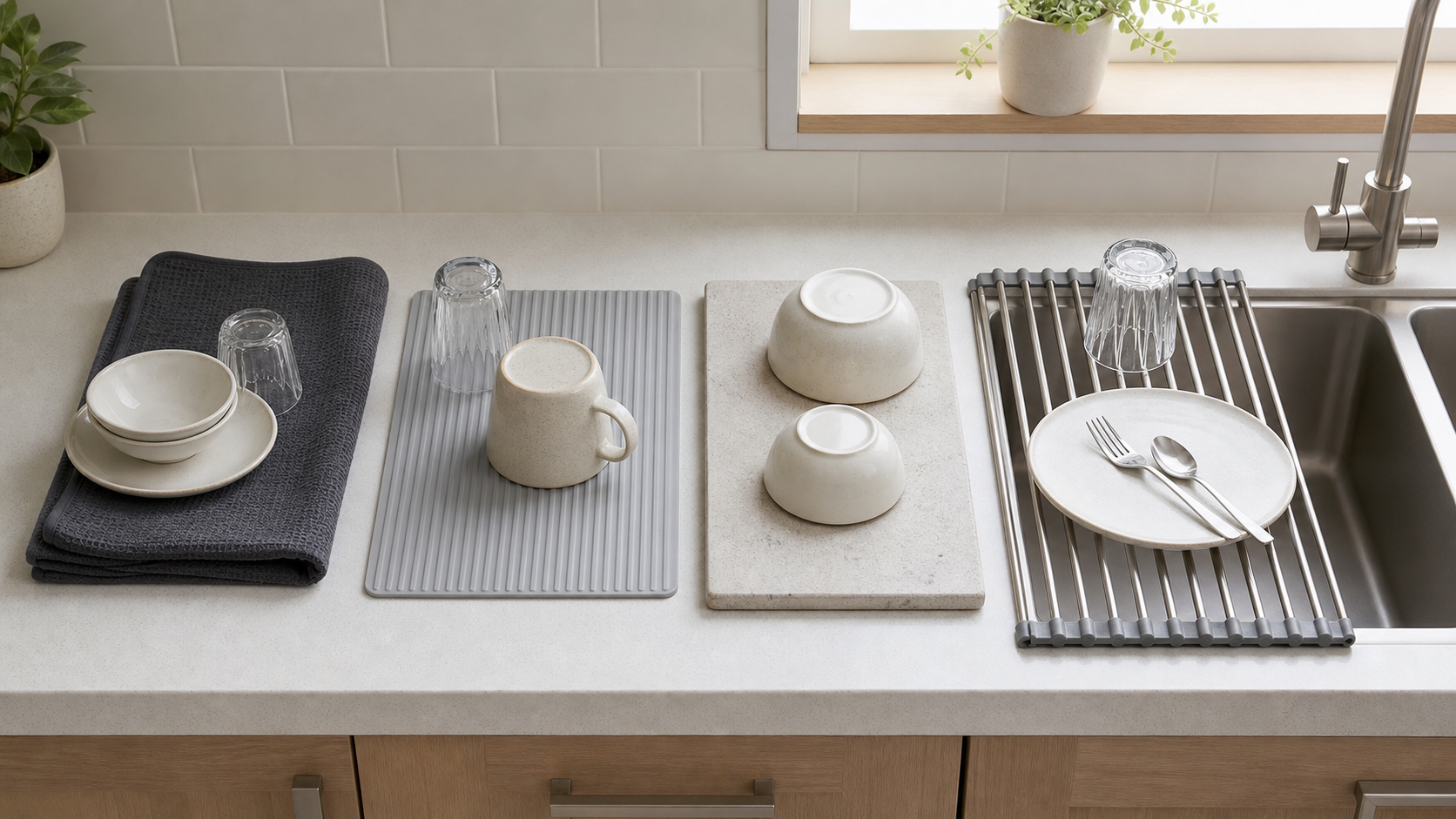
Product-category guide
Compare dish drying mat styles
Measure the landing zone first, then compare how each material handles water, cleanup, storage, fragile dishes, and the counter underneath.
This is a best-fit buying framework, not a ranked review or a claim that we tested individual products. Material labels do not guarantee performance, so check current dimensions, care instructions, heat limits, and surface warnings from the maker before buying.
Quick Picks by Kitchen Routine
- Best flexible choice for most occasional loads: a machine-washable microfiber mat sized for a few glasses, bowls, and utensils.
- Best for easy wipe-down: a ribbed silicone mat with a raised edge or a clear route for water to reach the sink.
- Best for fast surface drying and a fixed landing zone: a mineral or diatomaceous-style stone mat with clear care and resurfacing instructions.
- Best when the counter must stay clear: a roll-up over-sink mat that fits the sink securely and leaves enough basin access for rinsing.
- Best for stacked plates: none by itself; use a compact rack or plate holder when upright support and airflow matter.
Measure Before Comparing Materials
Measure the uninterrupted counter area beside the sink, not the whole countertop. Leave room for the faucet handle, soap dispenser, cabinet doors, outlets, and your main food-prep zone. If the mat will sit under an upper cabinet, make sure tall glasses and cutting boards have clearance.
For an over-sink style, measure the inside and outside sink width and check how much solid ledge supports the ends. Confirm faucet clearance and keep part of the basin usable. A mat that balances on a narrow rim or shifts when loaded is the wrong fit even if its listed width looks close.
Comparison Framework
Microfiber Mats
Microfiber mats cushion glassware, fold into a drawer, and absorb drips from small mixed loads. They are convenient only when you have a place to hang or spread them until fully dry.
Choose one if: you wash modest loads, want soft cushioning, and can launder it on the maker's schedule. Watch for: slow drying under stacked dishes, trapped moisture beneath the mat, lint, odors, and care instructions that limit heat or fabric softener.
Silicone Mats
Ribs lift dishes above pooled water and the nonabsorbent surface can usually be wiped or rinsed. Water remains on the mat until it evaporates or drains, so groove direction and edge design matter.
Choose one if: you prefer rinse-and-wipe cleanup and can tilt or position the mat toward the sink. Watch for: water trapped in deep grooves, mineral spots, floppy handling, and heat claims that exceed the manufacturer's stated limit.
Stone Drying Mats
Rigid porous mats draw surface water into the material and can look tidy in a permanent landing zone. They do not fold, may chip or stain, and need open airflow around them to dry.
Choose one if: you have a fixed, level counter area and mainly dry light everyday pieces. Watch for: brittleness, hard contact with delicate glass, discoloration, sanding or resurfacing upkeep, and products without clear material and cleaning instructions.
Roll-Up Over-Sink Mats
Silicone-edged metal rods drain into the basin and roll away after use. They preserve the counter but temporarily reduce sink access and can be awkward with small utensils.
Choose one if: the sink has secure ledges, you need the counter open, and the listed load guidance suits your dishes. Watch for: slipping ends, blocked faucet access, rods spaced too widely for utensils, scratches from grit, and using the mat as a cutting board unless the maker permits it.
Must-Have Features
- A realistic size: enough area for a normal hand-wash load without covering the prep space you were trying to save.
- A way to dry between uses: hanging loop, dishwasher-safe construction, open vertical storage, or another routine you will actually follow.
- Counter compatibility: read surface-care guidance, especially for wood, laminate seams, natural stone, and counters where moisture can collect underneath.
- Stable dish contact: cushioning or texture that keeps glasses and bowls from sliding without hiding sharp debris.
- Clear care instructions: confirm machine-wash, dishwasher, hand-wash, drying, and replacement guidance rather than assuming from the material name.
Nice-to-Have Features
- Two smaller mats instead of one large mat: useful when you want one in use while the other dries.
- Raised channels: helpful on silicone if their direction sends water somewhere useful rather than trapping it.
- Neutral reversible surfaces: convenient for rotating wear, but not a substitute for washing and fully drying both sides.
- A storage sleeve or strap: useful for roll-up styles only if the mat is dry before storage.
Drying Time, Mildew, and Counter Protection
No mat should remain wet under dishes indefinitely. Spread dishes apart, move them once dry, then lift the mat so its underside and the counter can dry. Wash or clean the mat according to its instructions; if odors or staining remain after proper care, replacement is usually more sensible than masking the problem.
A drying mat is not waterproof protection for vulnerable counters. Wipe standing water promptly, keep moisture away from seams and unfinished edges, and follow the counter manufacturer's care advice. Persistent swelling, discoloration, soft material, or musty odor deserves attention to the moisture source rather than a thicker mat.
Heat and Surface Limits
Do not assume a silicone or stone drying mat is a trivet. Heat resistance varies by product, and a material's theoretical limit is not the same as the finished product's approved use. Keep hot pans, appliance exhaust, and open flames away unless the maker specifically permits that temperature and application.
Who Should Skip a Dish Drying Mat
Skip a flat mat if you routinely wash large family loads, need plates held upright, or leave dishes drying overnight in tight stacks. A compact rack with active drainage will usually give dishes more separation and keep them off pooled water. The dish drying rack chooser explains when countertop, over-sink, roll-up, and two-tier systems fit better.
Also skip a stone mat if you need fold-away storage or routinely handle delicate stemware, and skip an over-sink mat if the sink rim cannot support it securely. If limited mobility or grip makes lifting wet mats difficult, prioritize a stable setup that can be cleaned without awkward carrying.
Bottom Line
For many small kitchens, a washable microfiber mat is the simplest occasional-use choice, while silicone suits households that prefer wipeable surfaces and stone fits a fixed, well-ventilated landing zone. Roll-up over-sink mats save the most counter space but demand the most careful measuring. Pick by daily workflow, then make drying the mat itself part of the routine.
For the broader cleanup system, continue with the low-effort home maintenance tools guide.