Best Dishwasher-Safe Cutting Boards for Busy Kitchens
The best dishwasher-safe cutting board for a busy kitchen is not just the one that can survive a hot wash once. It should fit your dishwasher, stay flat enough to use safely, clean up without extra fuss, and make everyday prep easier instead of adding one more hand-wash chore.
As an Amazon Associate, The Good Home Doc may earn from qualifying purchases.
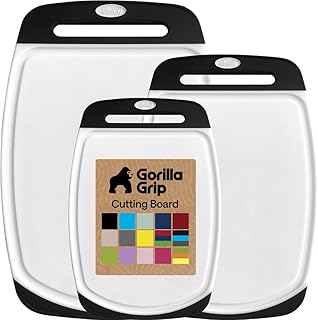
Product-first guide
Shop the products in this guide
Compare these affiliate product routes first, then use the guide criteria to check fit, measurements, setup limits, and maintenance.
This is a best-fit buying framework, not a ranked product review. Use it to compare plastic, composite, flexible, and color-coded cutting boards by dishwasher fit, warping risk, grip, knife marks, juice control, storage, and replacement habits. If you are building a broader low-effort kitchen reset, start with the low-effort home maintenance tools guide. For the drying side of the same workflow, the small-kitchen dish drying rack guide can help you plan counter space.
Quick Picks by Situation
- Best for most busy kitchens: a medium plastic board with non-slip edges, a usable prep surface, and a size that fits flat in your dishwasher rack.
- Best for raw meat prep: a dishwasher-safe plastic board that is easy to identify, clean promptly, and replace when deeply scored.
- Best for small kitchens: a thin composite or plastic board that stores vertically and still gives enough room for chopping without food spilling over the edge.
- Best for quick lunches: a lightweight board or small board set that can handle sandwiches, fruit, and snack prep without occupying the whole counter.
- Best to skip: any board that barely fits the dishwasher, rocks on the counter, traps water in grooves, or requires care you know you will not keep up with.
What Dishwasher-Safe Really Needs to Mean
Dishwasher-safe should mean the board can handle repeated washing according to the maker's care instructions without quickly warping, splitting, peeling, or losing its grip. It does not mean every board belongs in the hottest cycle, squeezed against a heating element, or left wet in a closed machine for hours.
The practical question is whether the board fits your daily routine. A beautiful board that must be hand-washed after every quick meal may be wrong for a household that cooks between work, school, errands, and late dishes. A cheaper board that warps after a few cycles may also be wrong if it makes chopping feel unstable.
Comparison Framework
Plastic Cutting Boards
Plastic boards are the common dishwasher-safe default. They are light, widely available, easy to color-code, and usually simple to replace when knife marks get deep.
Choose this type if: you want a low-maintenance board for everyday prep, raw meat, quick cleanup, or a household where boards go straight into the dishwasher.
Watch out for: thin boards that warp, slick boards without grip, deep knife grooves that hold residue, and oversized boards that only fit the dishwasher at an awkward angle.
Composite Cutting Boards
Composite boards are often made from compressed paper or fiber materials with resin. Some are dishwasher-safe, feel firmer than thin plastic, and can store neatly in a small kitchen.
Choose this type if: you want a sturdier-feeling board that is still lower maintenance than wood and the care label clearly allows dishwasher cleaning.
Watch out for: higher cost, manufacturer limits on heat cycles, edge wear, and boards that become slippery if they do not have feet or a damp towel underneath.
Flexible Cutting Mats
Flexible mats are thin, light, and easy to move from counter to pan. They can be handy for small prep jobs and color-coded tasks, but they are not always pleasant for heavy chopping.
Choose this type if: you need a low-profile board for quick prep, camping-style storage, or a tiny kitchen with very limited cabinet space.
Watch out for: curling edges, sliding, knife cuts that show quickly, and mats that fold in the dishwasher instead of washing flat.
Board Sets
Sets can work well when different people cook at different times or when you want separate boards for produce, bread, and raw proteins. The useful set is the one where every board has a job.
Choose this type if: your kitchen needs more than one clean board available during dinner prep or packed-lunch prep.
Watch out for: bundled boards that are too small to use, bulky stands that collect crumbs, and color systems your household will not actually follow.
Must-Have Features
- Dishwasher fit: Measure your dishwasher rack before buying a large board. A board that blocks the spray arm or must bend to fit will not wash well.
- Stable grip: Rubber feet, grippy edges, or enough weight help the board stay put. A damp towel underneath can help, but the board should not feel unsafe on its own.
- Enough usable surface: Small boards are easy to clean, but they become annoying if chopped food falls onto the counter.
- Low warping risk: Thicker plastic and quality composite boards usually hold shape better than very thin bargain boards.
- Clear care instructions: Look for plain guidance about dishwasher placement, heat limits, and whether the board should avoid heated dry cycles.
- Replaceable price point: Cutting boards are wear items. If you will hesitate to replace a deeply scarred board, it may be too precious for your daily routine.
Nice-to-Have Features
- Juice groove: Useful for fruit, roasts, and juicy ingredients, but harder to wipe quickly than a flat board.
- Color coding: Helpful for separating raw proteins from ready-to-eat foods when everyone in the kitchen follows the system.
- Hanging hole or slim profile: Makes vertical storage easier in tight cabinets or beside a dish rack.
- Reversible sides: Gives you more usable surface before the board looks worn, as long as both sides stay stable.
- Textured surface: Can reduce slipping food, but very rough texture may be harder to rinse clean.
Size and Storage Matter More Than They Seem
Before buying, measure the counter landing zone, dishwasher rack, cabinet slot, and dish-drying area. A board can be technically dishwasher-safe and still be too tall for the rack, too wide for your sink, or too bulky to store near the prep zone.
For small kitchens, one medium everyday board plus one small quick-prep board is often more useful than a huge board that monopolizes the counter. If you batch-cook or prep large vegetables, go larger only if the board still fits the dishwasher and your storage spot.
Sanitation and Replacement Habits
Use the board according to basic food-safety habits: wash it after raw meat, poultry, seafood, and messy produce; keep ready-to-eat foods away from contaminated surfaces; and let the board dry before storage. Follow current food-safety guidance from reliable public-health sources for your household's cooking habits.
Replace a board when deep cuts, fuzzy plastic, peeling layers, trapped odor, warping, or unstable feet make it hard to clean or use confidently. Dishwasher cleaning helps with routine cleanup, but it does not make a damaged board new again.
Who Should Skip Dishwasher-Safe Boards
Skip dishwasher-safe plastic as your main board if you strongly prefer the feel of wood and are willing to hand-wash, dry, and maintain it properly. Wood and bamboo can be excellent prep surfaces, but many are not dishwasher-safe and can crack, warp, or lose finish when treated like plastic.
Also skip very thin flexible mats if you chop hard squash, dense vegetables, or large batches often. They are better as helper mats than as the only serious prep surface. If your dishwasher runs very hot or has an aggressive heated dry cycle, check care labels carefully and choose boards that match that reality.
Best Setup for a Busy Kitchen
- Keep one everyday board within reach. It should be large enough for dinner prep but small enough to wash and store without negotiation.
- Add a second board only for a clear reason. Raw protein prep, school lunches, or produce overflow are good reasons; duplicate clutter is not.
- Check dishwasher placement. Load boards so water can reach both sides and the board does not block the spray arm.
- Dry before storage. A wet board tucked into a tight cabinet can hold odor and grime even if it just came through the dishwasher.
- Replace worn boards without drama. A cutting board is doing real work; visible deep wear is a cue to move on.
If your cutting board usually sits beside a crowded sink, pair this decision with the dish drying rack guide for small kitchens so clean boards, knives, plates, and pans all have a realistic place to land.
Bottom Line
For most busy kitchens, the best dishwasher-safe cutting board is a medium plastic or dishwasher-approved composite board with stable grip, enough working space, clear care instructions, and a size that fits your dishwasher without blocking the rack. Choose flexible mats for quick helper tasks, board sets only when each board has a real job, and hand-wash-only boards only if you truly want the extra care routine.