Best Drying Racks for Sweaters and Delicates
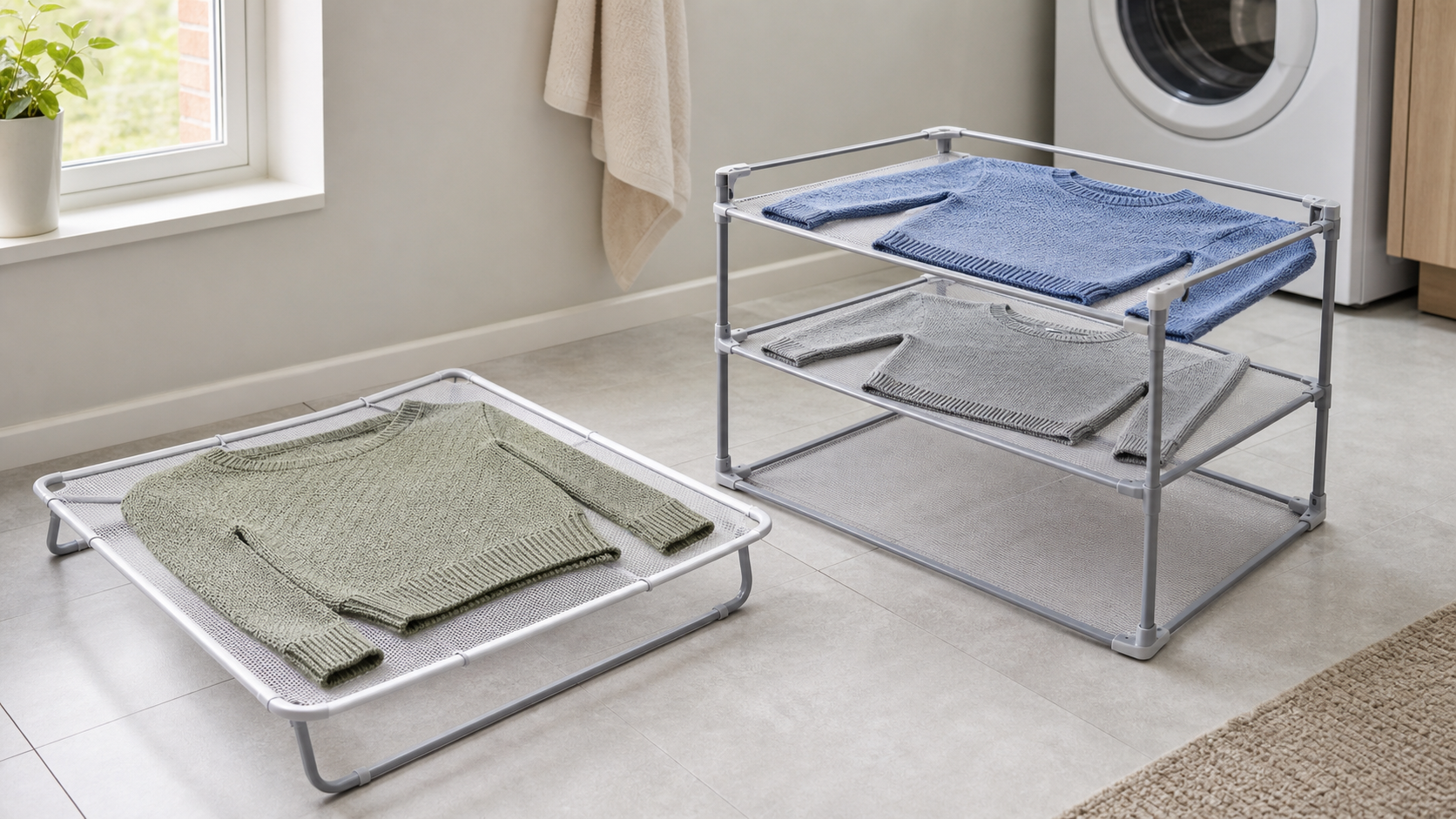
The best drying rack for sweaters supports the whole garment without stretching the shoulders or trapping damp fabric against a solid surface. A single mesh rack is the simplest choice for one or two knits; stackable tiers make better use of floor space; and over-tub formats help contain drips when hand-washed items cannot be pressed nearly dry.
As an Amazon Associate, The Good Home Doc may earn from qualifying purchases.
Compare the support format first: These affiliate category links are shopping starting points, not tested rankings.
- Browse category: Single-level mesh sweater racksThe straightforward choice for occasional flat drying and easy access to one garment.
- Browse category: Stackable mesh drying racksUseful for several lightweight knits when tier spacing and frame stability are adequate.
- Browse category: Over-tub flat drying racksWorth comparing for hand-washed items that may still drip, provided the rack fits the tub securely.
Confirm the open dimensions, usable mesh area, stated load guidance, tier clearance, assembly, and care instructions with the manufacturer before buying.
This guide compares rack formats and fit rather than claiming one unsupported overall winner. Always follow the garment care label first. “Dry flat,” “reshape and dry flat,” and “line dry” are not interchangeable instructions, and a rack cannot make machine washing or wringing safe for a garment that requires a different process.
Quick Picks by Laundry Routine
- Best for one or two sweaters: a rigid single-level frame with taut, washable mesh and enough area to keep sleeves on the rack.
- Best for several lightweight knits: a stackable rack with useful vertical clearance and stable corner connections.
- Best for items that may drip: an over-tub rack that rests securely on both tub edges without blocking drainage.
- Best for tiny storage spaces: a fold-flat or twist-fold mesh rack whose folded size fits the actual closet or laundry shelf.
- Best for heavy wet garments: a low, rigid rack with manufacturer guidance that covers the load; avoid tall, flexible stacks.
Measure the Garment, Drying Spot, and Storage Spot
Measure a representative sweater from shoulder to hem and across the sleeves when arranged naturally. The rack’s advertised outside dimensions can overstate the usable mesh area because the frame and rounded corners take up space. Sleeves hanging over an edge dry unevenly and may pull on a wet knit.
Then measure where the open rack will sit. Leave airflow around the sides and enough walking clearance that the rack will not become a trip hazard. A water-resistant floor, bathtub, or well-ventilated laundry area is a better choice than placing damp fabric over wood furniture or carpet. Finally, check the folded dimensions; “collapsible” does not necessarily mean small enough for a narrow closet.
Comparison Framework
Single-Level Mesh Racks
A low rectangular mesh platform gives one garment unobstructed airflow above and below. It is easy to load, reshape, turn if the care instructions allow, and inspect for remaining damp areas.
Choose one if: you usually dry one sweater at a time, have enough temporary floor or counter space, and value simple setup.
Watch for: mesh that sags until the garment touches the floor or counter, a frame smaller than your sweater, rough seams, and legs that fold without a positive stop.
Stackable Tier Racks
Stacked mesh platforms hold several items within one footprint. They are efficient, but the lower garments receive less open space above them and are harder to reposition. Wide sweaters can also block air through the center of the stack.
Choose one if: you wash several lightweight knits together and can leave the assembled tower undisturbed.
Watch for: shallow tier spacing, loose corner joints, a narrow base, excessive overall height, and load descriptions that apply to the entire unit rather than each tier.
Over-Tub Racks
Over-tub racks keep drips over a drain and save floor space elsewhere. Some are mesh platforms; others are rigid slatted frames better suited to items that can rest without pressing into large gaps.
Choose one if: hand-washed pieces retain water and your tub has two clear, level edges that match the rack’s adjustment range.
Watch for: rounded or narrow tub rims, controls that interfere with the frame, a slippery contact surface, rust-prone parts, and a rack that prevents safe use of the bathroom.
Hanging Multi-Tier Mesh Dryers
Hanging tiers suspend from a shower rod or sturdy clothes rod and store compactly. They can sway while being loaded and often have flexible circular platforms that limit how neatly a larger sweater can be shaped.
Choose one if: floor space is unavailable, garments are light, and the support point is allowed to carry the combined wet load.
Watch for: unstable loading, small tier diameters, fabric touching the tier above, and hanging the unit from a tension rod or fixture not intended for the weight.
Must-Have Features
- Enough usable mesh area: The body and sleeves should remain supported without bunching or dangling.
- Taut, smooth support: Mesh should allow airflow without deep sag, abrasive seams, exposed fasteners, or points that can catch a knit.
- Stable geometry: Feet and joints should resist rocking when one side is loaded first. Stability matters more than maximum tier count.
- Practical airflow: Look for open mesh below and clear space above each garment, especially on stacked racks.
- Cleanable materials: Detergent residue and lint collect on mesh and frames. Follow the rack maker’s cleaning guidance and let it dry before storage.
- A storage method you will use: Check whether folding requires disassembly and whether flexible frames twist closed without fighting spring tension.
Nice-to-Have Features
- Independent tiers: Removable levels let you increase clearance for thick garments or use only the capacity needed.
- Raised edge piping: A subtle edge can help keep sleeves on the mesh, provided it does not leave a pressure line.
- Replaceable mesh: Useful when the frame is durable but fabric support may stretch or snag over time.
- Non-marking feet: Helpful on tile or a protected counter, though wet racks should not sit directly on moisture-sensitive surfaces.
- A storage strap or bag: Keeps folded parts together and protects mesh from closet hooks or rough tools.
Garment Weight, Water, and Airflow
A saturated sweater can weigh far more than it does dry. Remove water only in a way permitted by the care label—often by gently pressing rather than twisting—and support the whole garment when moving it. Do not assume a rack shown with a light shirt can hold a heavy wet wool knit.
Reshape the garment on the rack instead of stretching it to fill the platform. Smooth thick folds, separate sleeves from the body, and keep fabric away from radiators, open flames, and direct heat unless the care label specifically permits that method. A fan may improve room airflow, but do not place cords or electrical appliances where dripping water can reach them.
Who Should Skip a Flat Drying Rack
Skip this category if the garment label calls for line drying, tumble drying, or professional cleaning rather than flat drying. Also skip a floor rack if there is no place to leave it open without blocking a doorway, creating a trip risk, or allowing children or pets to disturb it.
Skip a tall stackable unit for heavy, saturated garments unless the manufacturer clearly supports that load and the base remains stable. Skip an over-tub rack if the tub edges are curved, obstructed, or outside the product’s fit range. For occasional small delicates, a clean towel laid on a water-safe, ventilated surface may be simpler if the garment instructions allow it.
Buying Checklist
- Read the care labels on the garments you actually plan to dry.
- Measure the largest garment when laid flat, including its sleeves.
- Compare that measurement with the rack’s usable mesh area, not only its outside frame size.
- Choose one open tier for simplicity or multiple tiers only when you need the capacity.
- Check tier clearance, frame stability, mesh sag, and manufacturer load guidance.
- Confirm the open rack has a water-safe, well-ventilated location.
- Verify the folded rack fits its intended storage spot and can dry fully before being put away.
Bottom Line
For most households drying one sweater at a time, a low single-level rack with taut mesh, full sleeve support, stable legs, and genuinely compact storage is the least fussy choice. Choose stackable tiers when capacity matters more than easy access, or an over-tub design when controlling drips is the main problem. The right rack is the one that matches the care label, supports the entire wet garment, and can remain open without compromising the room around it.