Best Freestanding Room Dividers for Studio Apartments
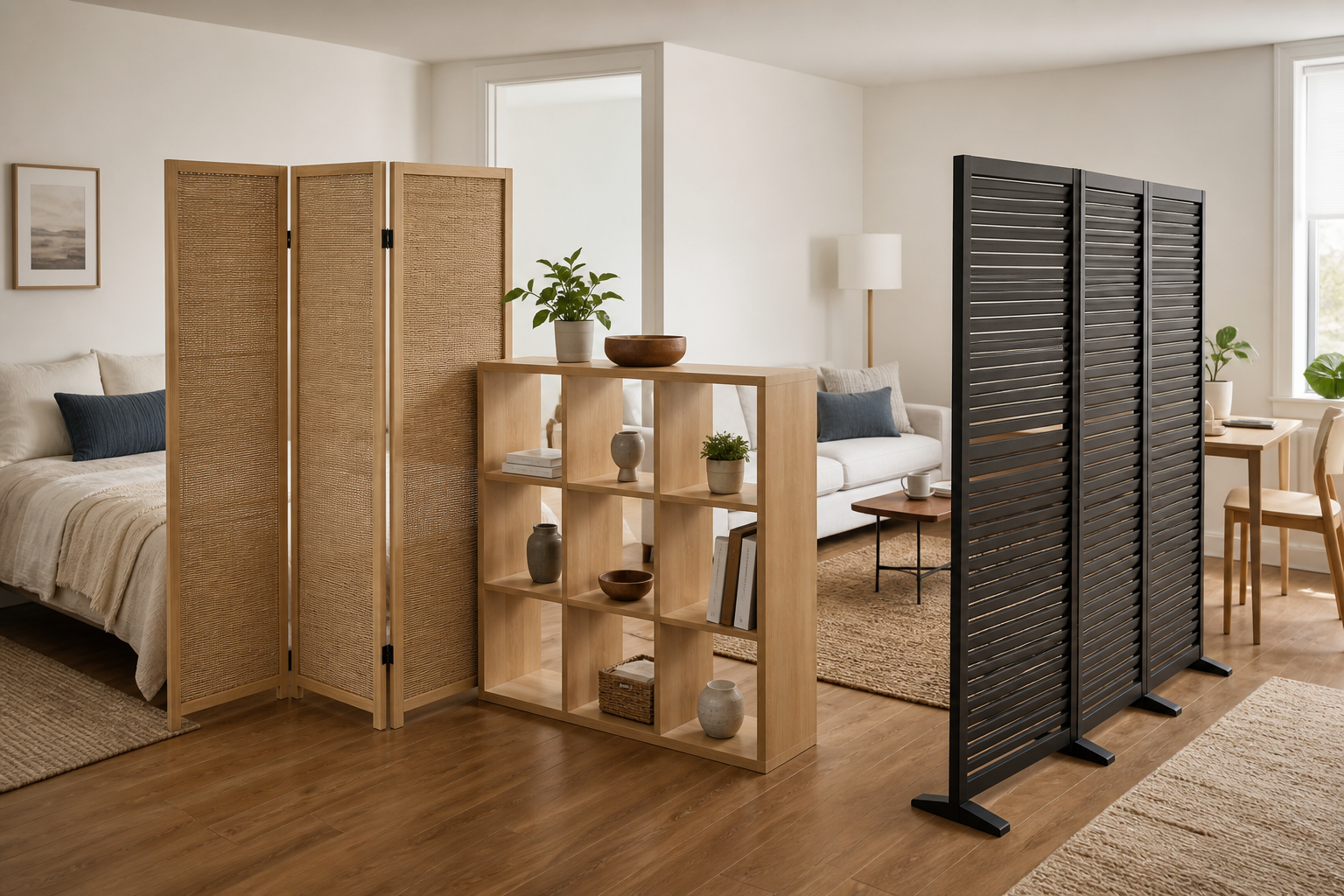
The best room divider for a studio creates a useful visual boundary without stealing the walkway, blocking the apartment's only daylight, or becoming unstable in daily traffic. Folding screens are the simplest flexible choice; open shelving adds storage but needs much more caution; and slatted panels preserve more light while defining a zone.
As an Amazon Associate, The Good Home Doc may earn from qualifying purchases.
Start with the divider format that fits your floor plan: These affiliate category links are shopping starting points, not tested rankings.
- Browse category: Folding room-divider screensFlexible visual separation with no wall attachment and compact folded storage.
- Browse category: Open cube shelf dividersStorage plus zoning, but only where the furniture can be secured as the manufacturer directs.
- Browse category: Freestanding slatted dividersA lighter-looking boundary that allows daylight and sightlines through.
Confirm assembled width and height, floor footprint, weight, panel material, base design, assembly, anchoring instructions, return policy, and lease rules before buying.
This is a category-fit guide, not a brand ranking or hands-on test. It supports the renter-friendly home upgrades pillar. If your main problem is a dark studio rather than zoning, start with the small living-room floor lamp guide instead.
Quick Picks by Studio Problem
- Best for flexible zoning: a hinged folding screen that stands in a shallow zigzag and folds away when you need the full room.
- Best for keeping daylight moving: an open slatted panel or open-backed screen with a wide, stable base.
- Best when storage is essential: a low open shelf only when its size, load, placement, and required restraint method suit the apartment.
- Best for frequent rearranging: a lightweight screen with durable hinges and handles or edges that are comfortable to grip.
- Best to skip: a tall, narrow unit that cannot follow its manufacturer-required anchoring directions or crowds the only safe path through the studio.
Comparison Framework
Folding Screens
Three- or four-panel screens create privacy by standing in a shallow accordion shape. They require no storage load and can move as the studio changes from sleeping to working or entertaining.
Choose one if: you want a visual boundary that can fold away. Skip it if: the floor is uneven, the screen must stand nearly flat to fit, or children, pets, drafts, and busy traffic make a lightweight panel easy to knock.
Open Shelf Dividers
An open shelf can organize books, baskets, and daily supplies while marking a boundary. It also puts weight above the floor and may be accessible from both sides, so stability and manufacturer instructions are the deciding criteria—not just storage capacity.
Choose one if: a low, broad unit fits the floor plan and you can use every required restraint or anti-tip provision. Skip it if: the lease prevents required attachment, the unit would be climbed, or bins and decor would make it top-heavy.
Slatted or Open-Frame Panels
Vertical slats and open frames define a sleeping or work zone without making the studio feel like two dark boxes. They offer less privacy than an opaque screen and typically need a larger base than photos suggest.
Choose one if: daylight and airflow matter more than full visual coverage. Skip it if: the base creates a trip point or the panel's height and leverage exceed what the base can support in your traffic pattern.
Fabric Panels on Freestanding Frames
Fabric panels can be lighter and softer-looking than wood, but they may collect dust, wrinkle, or sway. Check whether the cover removes for cleaning and whether the frame remains stable without tensioning it to a wall or ceiling.
Choose one if: washable coverage and lower weight matter. Skip it if: the fabric sits near a heater, blocks required ventilation, or becomes a grab point in a busy room.
Measure the Zone, Not Just the Divider
- Mark the normal path from the entry to the bathroom, kitchen, windows, and sleeping area. Keep doors, exits, vents, radiators, and required access clear.
- Measure the maximum divider width, then subtract the depth needed for feet, bases, or a folding screen's zigzag stance.
- Check sightlines while sitting and standing. A lower divider may provide enough separation without blocking daylight.
- Open nearby drawers, cabinet doors, closet doors, and sofa beds. Include their full swing or pullout depth.
- Use painter's tape to outline the base for a day and walk the normal routes before ordering.
Must-Have Selection Criteria
- Stable geometry: folding panels need enough angle between sections; rigid panels need feet or a base sized for their height.
- A clear circulation path: the divider should not create a pinch point, hidden corner, or obstacle between the bed and exit.
- Appropriate light flow: opaque panels provide more visual privacy, while slats, cane, and open shelves preserve daylight.
- Realistic storage: if the divider has shelves, compare the maker's load guidance and keep heavier items low.
- Lease-compatible setup: “freestanding” does not always mean attachment-free; follow required anchoring instructions and get permission where needed.
- Maintainable surfaces: choose panels, hinges, fabric, and shelves you can dust or clean without dismantling the room.
Nice-to-Have Features
- Two-way finish: useful when both the sleeping and living sides remain visible.
- Replaceable or washable fabric: makes a soft divider easier to maintain in a cooking-and-living space.
- Leveling feet: helpful on slightly uneven hard floors, provided they do not reduce the contact area or grip.
- Integrated handles: make a folding screen easier to reposition without pulling on the panel material.
- Open lower sightline: can make a divider feel less bulky, though it provides less concealment.
Stability Around Children, Pets, and Daily Traffic
No tall freestanding divider is impossible to tip. Follow the product's assembly, placement, load, and anchoring directions. Do not assume a wall restraint is optional because a listing calls the product freestanding. Keep climbable shelves away from children's activity zones, place heavy objects low, and avoid using a divider as a television stand unless the manufacturer specifically supports that use.
If the only workable layout blocks an exit, crowds a heater or vent, or prevents required attachment, choose a lower boundary such as a sofa back, rug, lighting change, or open garment rack designed for the load. Ask the landlord before drilling or attaching anything, and use a qualified installer when the instructions or wall conditions are beyond your experience.
Privacy and Noise: Set Realistic Expectations
A room divider changes sightlines; it does not turn a studio into a soundproof one-bedroom. Gaps at the ceiling, walls, and floor allow sound to travel around any freestanding panel. Thick fabric may soften some reflections, but unsupported noise-reduction promises should not drive the purchase.
For a work corner, put the divider between the visual distraction and the desk, then use soft furnishings already appropriate for the apartment. For a sleeping zone, prioritize a clear nighttime path and access to windows, ventilation, and climate controls over complete concealment.
Who Should Skip a Freestanding Divider
- Skip a folding screen if it must stand flat, will sit in strong drafts, or will be bumped repeatedly.
- Skip a shelf divider if required restraint conflicts with the lease or the household cannot prevent climbing and top-heavy loading.
- Skip an opaque divider if it would block the studio's only practical daylight or ventilation path.
- Skip a tall slatted panel if its feet intrude into the walkway or the base cannot stay fully on one level surface.
- Skip the category entirely if furniture placement, a rug, a curtain installed with permission, or lighting can define the zone with less floor space and risk.
Bottom Line
For most studio renters, a well-proportioned folding screen is the most adaptable starting point because it creates visual separation and stores compactly. Choose an open slatted divider when daylight matters, and consider a shelf divider only after resolving its footprint, loading, restraint, and lease requirements. Measure the entire circulation zone and follow the manufacturer's stability directions—the divider should simplify a studio, not make it harder to move through safely.