Best Handheld Vacuums for Stairs and Car Interiors
A handheld vacuum earns its storage space when it can reach stair edges, seat seams, floor rails, and tight corners without becoming tiring to hold. The right choice depends less on headline power claims and more on weight, attachments, bin cleanup, charging location, and whether its usable runtime matches your cleanup routine.
As an Amazon Associate, The Good Home Doc may earn from qualifying purchases.
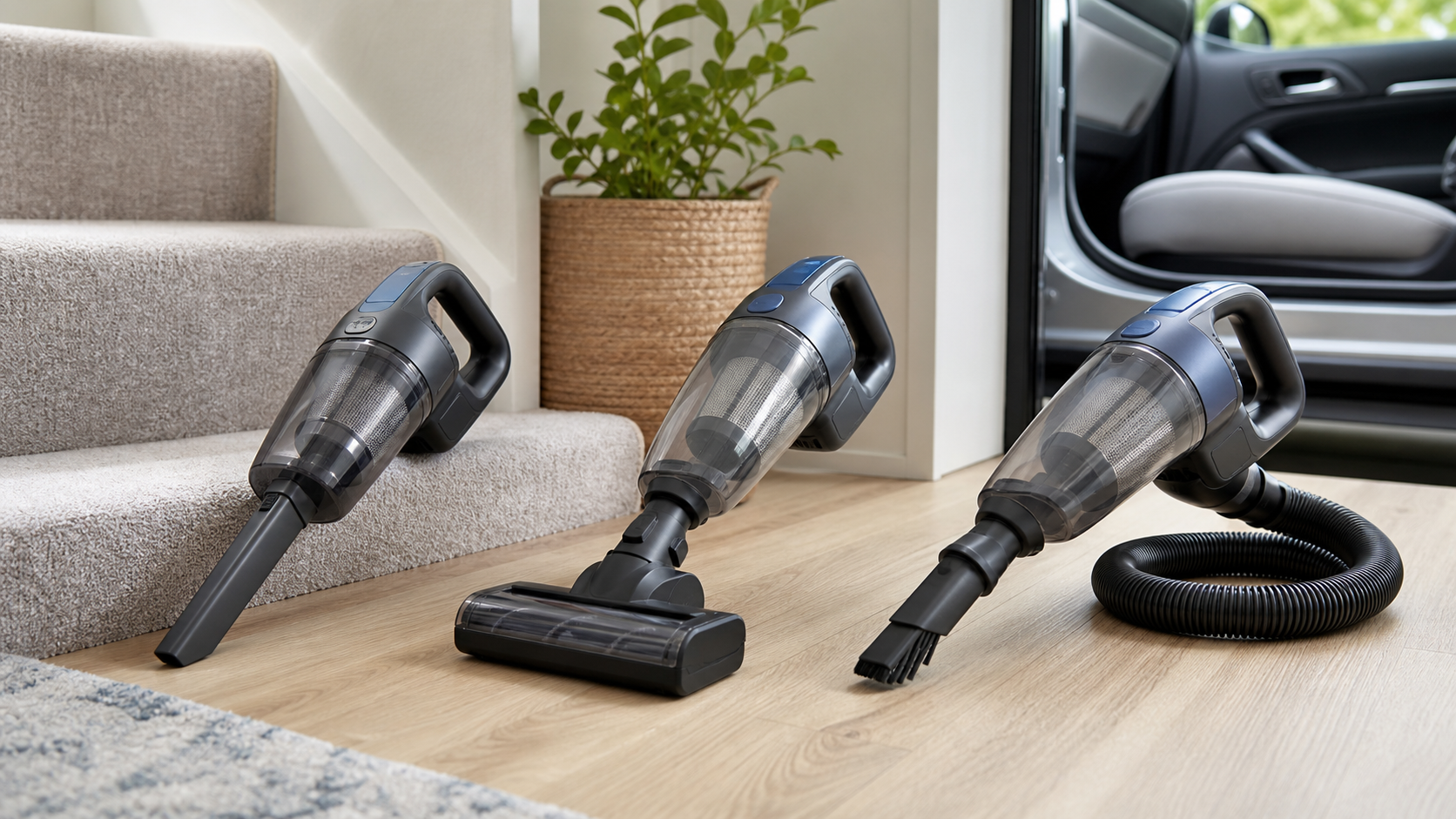
Product-category guide
Match the tool to stairs, seats, and narrow gaps
Compare manufacturer-stated weight and runtime, then check whether the included attachments fit your stair covering, upholstery, car rails, and storage space.
This is a best-fit buying framework, not a ranked review or a claim that we tested individual vacuums. Verify current weight, runtime, charge time, included tools, filter care, replacement-part availability, and surface guidance with the manufacturer.
Quick Picks by Cleanup Problem
- Best for stair edges and car rails: a compact model with a long, narrow crevice tool that locks securely in place.
- Best for carpeted stairs and fabric seats: a balanced handheld with a small powered upholstery head and an easy-to-clear brush roll.
- Best for awkward footwells: a model with a flexible hose, provided the hose and body remain manageable together.
- Best for quick crumb pickup: a lightweight basic handheld with a wide nozzle and a charging spot near the mess.
- Best for larger whole-home jobs: usually not a handheld at all; compare a cordless stick vacuum with a removable handheld unit.
Start With the Surfaces and Gaps You Actually Clean
List the jobs before comparing models: flat stair treads, carpeted risers, hard stair nosings, fabric seats, floor mats, door pockets, seat rails, or loose crumbs on hard surfaces. A plain nozzle may handle visible debris, while embedded hair on upholstery can benefit from a powered brush. A crevice tool reaches narrow channels but covers open areas slowly.
Measure the narrowest gap you want to reach and note the depth. Check the tool's full dimensions rather than assuming every crevice nozzle fits between a car seat and console. For stairs, consider where you will set the vacuum while changing attachments; a rounded body that cannot rest securely can roll or slide.
Comparison Framework
Compact Fixed-Nozzle Handhelds
These simple models are easy to grab for crumbs and surface debris. Fewer attachments mean less storage clutter, but the fixed shape can limit access around stair corners and car hardware.
Choose this type if: low weight and fast spot cleanup matter more than deep upholstery work.
Watch out for: short nozzles, small bins, and filters that sit directly in the dirt path and need frequent attention.
Handhelds With a Powered Upholstery Head
A small rotating brush can agitate carpeted stair treads and fabric seats. It also adds bulk, draws on the battery, and can wrap hair around the brush.
Choose this type if: carpet, pet hair, or fabric upholstery makes up much of the job and the maker approves the attachment for those surfaces.
Watch out for: delicate fabrics, looped carpet, brush-roll tangles, and a head too wide for the usable part of each stair.
Flexible-Hose Handhelds
A hose lets the nozzle move independently while the motor unit stays in your other hand or rests on a stable surface. This can improve reach under seats, though managing two pieces is less convenient for quick crumbs.
Choose this type if: car footwells, seat rails, and irregular corners are the main problem.
Watch out for: hose kinks, awkward body placement, reduced storage simplicity, and debris catching in narrow bends.
Convertible Stick Vacuums
Some stick vacuums detach into handheld units, combining floor cleaning and spot work in one purchase. The detached motor unit may be heavier or bulkier than a dedicated handheld.
Choose this type if: you also need routine floor cleaning and want one battery platform and storage station.
Watch out for: paying for a full stick system when stairs and the car are your only jobs, plus attachments sold separately.
Must-Have Features
- Manageable ready-to-use weight: Compare weight with the battery and intended tool attached, not only the bare unit.
- Secure attachments: Tools should click or seat firmly so they do not fall off over stairs or inside the car.
- Reachable bin release: You should be able to empty debris without gripping a dirty filter or scattering dust back onto the floor.
- Washable or replaceable filter guidance: Follow the maker's care schedule and confirm replacement filters remain practical to obtain.
- A workable charging plan: Check cord length, dock orientation, charge time, and whether the battery or unit can be stored in a dry, temperature-appropriate place.
Nice-to-Have Features
- Battery indicator: More useful than discovering mid-staircase that the remaining charge is low.
- Removable battery: Can simplify replacement or allow a spare, but only when current compatible batteries are available.
- Brush-roll access: A removable cover or roll makes wrapped hair easier to clear with the unit off and the battery removed when the maker directs.
- Tool storage: A dock or caddy keeps the crevice and brush tools from disappearing into a cabinet.
- One-hand controls: A continuous trigger can become tiring; a latching power switch may suit longer stair or car sessions better.
Runtime Claims Need Context
Use manufacturer runtime as a comparison input, not a promise for every job. Powered brush heads and higher settings commonly change runtime, while battery age and temperature can affect performance. Look for runtime stated with the attachment and mode you intend to use, then compare it with how long your stairs or car normally take.
Charge time matters when the vacuum cannot finish your routine in one session. A model that lives plugged in may be convenient, but follow the manufacturer's charging and storage instructions. Do not leave a battery or vacuum loose in a hot vehicle, and do not use or charge damaged battery packs.
Bin and Filter Care
Small bins fill quickly with hair and bulky crumbs. Compare the fill line, opening size, and whether the filter must be removed during emptying. Empty the bin before debris packs around the filter, and let washable parts dry fully for the time specified by the maker before reassembly.
A handheld vacuum is for dry debris unless its manufacturer explicitly states otherwise. Do not collect hot ash, sharp debris, liquids, or fine construction dust with an ordinary household model. If the unit, battery, or charger is cracked, swollen, unusually hot, or damaged, stop using it and follow the manufacturer's service or disposal guidance.
Who Should Skip a Handheld Vacuum
Skip a dedicated handheld if you need to clean several rooms, large carpeted areas, or an entire vehicle in one pass; a larger cordless or corded vacuum may provide a bigger bin and a more comfortable floor tool. Skip powered brushes for surfaces the manufacturer excludes, and avoid a heavy handheld if wrist or grip comfort makes sustained one-handed use difficult.
Also skip models whose replacement filters, batteries, or attachments are difficult to identify. A low purchase price is less useful if the filter cannot be maintained or the battery is not serviceable under the maker's stated options.
Bottom Line
For mixed stair and car cleanup, the strongest all-around fit is usually a balanced cordless handheld with a secure crevice tool, an upholstery brush suited to your surfaces, straightforward bin emptying, and enough manufacturer-stated runtime for one normal session. Choose a powered head for carpet and fabric, or a flexible hose for deep vehicle gaps, only when those jobs justify the extra weight and storage.
For a broader kit built around repeat chores rather than product hype, continue with the low-effort home maintenance tools guide. If a handheld would duplicate another vacuum, use the home product buying framework to compare total storage, maintenance, and replacement costs.