Best Refillable Soap Dispensers for Kitchen Sinks
The best refillable soap dispenser is easy to press with wet hands, stays put beside the sink, accepts the soap you use, and opens wide enough to refill and clean without a mess. A compact countertop pump is the easiest low-commitment choice; a deck-mounted pump can clear the counter when the sink already has a compatible unused opening.
As an Amazon Associate, The Good Home Doc may earn from qualifying purchases.
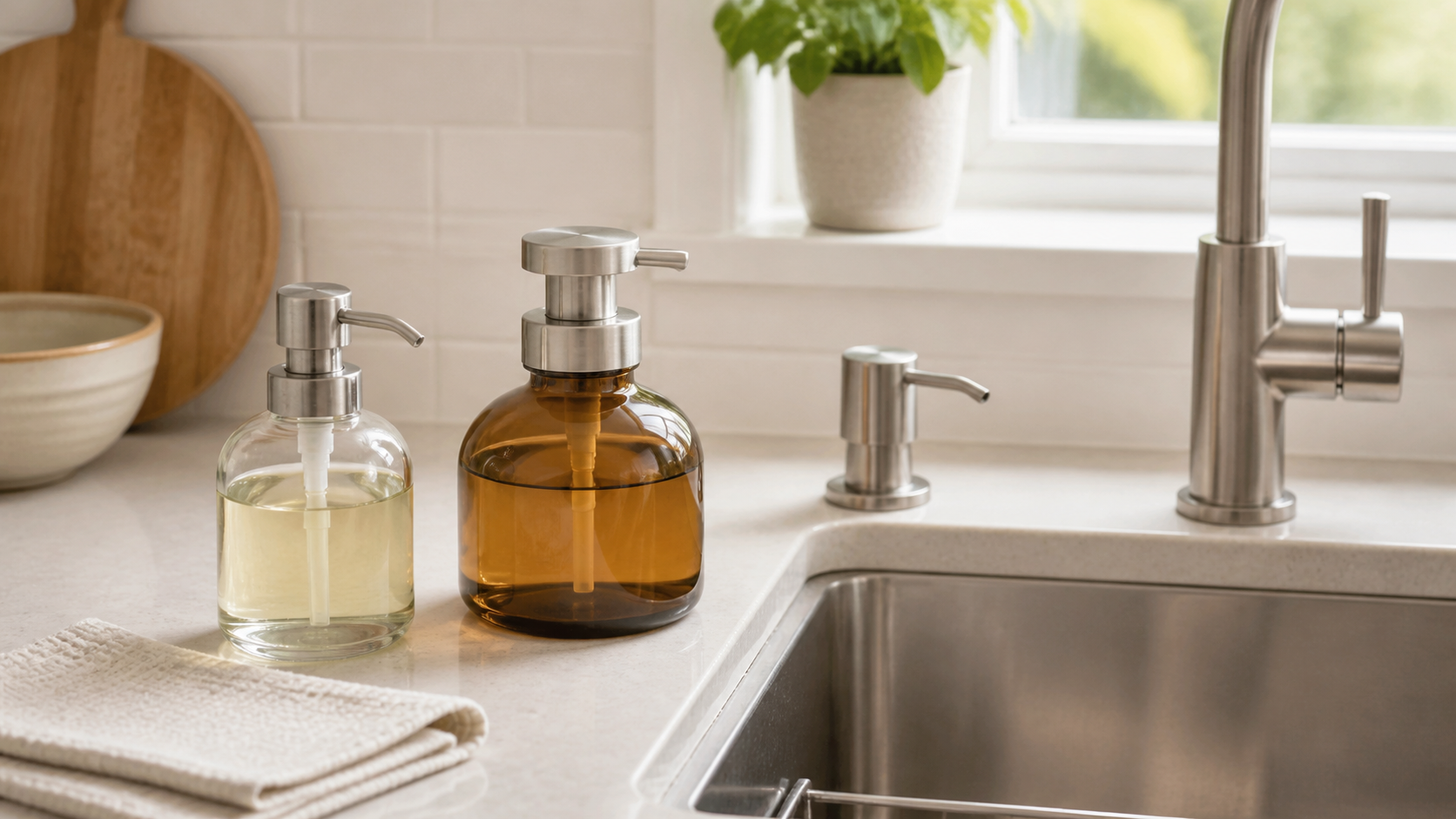
Start with the installation style: These affiliate category links are shopping starting points, not tested brand rankings.
- Browse category: Countertop refillable soap dispensersBest for renters, simple refills, and sinks without a suitable accessory opening.
- Browse category: Deck-mounted kitchen soap dispensersWorth comparing when a compatible existing sink or counter opening is available.
- Browse category: Wide-mouth countertop dispensersUseful when easy bottle cleaning and spill-resistant refilling matter most.
Confirm exterior dimensions, pump material, refill opening, capacity, soap-viscosity guidance, base grip, and deck-hole requirements before buying.
This is a category comparison, not a ranking of current named products. Pump feel, compatibility, dimensions, care directions, and installation requirements vary, so verify them on the current listing and manufacturer instructions.
Quick Picks by Sink Setup
- Best for most renters: a compact countertop bottle with a grippy base, removable pump, and wide refill opening.
- Best for a crowded counter: a deck-mounted, top-refill pump—but only when a compatible existing opening and accessible bottle space are available.
- Best for frequent refills: a wide-mouth bottle whose fill level is visible without lifting it.
- Best for thick soap: a pump whose maker explicitly lists compatibility with that viscosity.
- Best for easy cleanup: a simple bottle with few seams, a removable pump tube, and clear wash instructions.
Measure the Sink Zone First
For a countertop dispenser, measure the dry landing area beside the sink, including faucet-handle movement, backsplash clearance, and the space needed to lift or unscrew the pump. Leave enough room to wipe beneath the bottle instead of wedging it against the faucet or wall.
For a deck-mounted pump, confirm that an existing opening is intended and suitable for an accessory. Check the listed hole-diameter range, maximum deck thickness, reach over the sink, and bottle clearance below. Do not drill a sink or countertop as an improvised installation step. Material, warranty, plumbing, and rental restrictions can make that a job for the manufacturer, landlord, installer, or another qualified professional.
Comparison Framework
Compact Countertop Pumps
These are portable, installation-free, and easy to replace. A shorter bottle is less likely to tip, while a clear or translucent body makes the remaining soap easier to see.
Choose this type when: you rent, switch soaps often, or want the easiest bottle to remove for cleaning.
Watch for: a narrow top that needs a funnel, a lightweight base, pumps that overhang the counter edge, hard-to-clean seams, and materials not listed for the chosen soap.
Wide-Base or High-Capacity Countertop Pumps
A wider base can resist tipping and a larger bottle reduces refill frequency, but both use more sink-side space. Usable capacity matters less than whether the dispenser blocks cleaning or faucet controls.
Choose this type when: several people use the sink frequently and there is a stable, wipeable landing area.
Watch for: oversized bottles that stay damp underneath, slippery glass on a hard counter, awkward wet handling, and pump tubes that do not reach the bottle bottom.
Deck-Mounted Pumps
A deck-mounted pump keeps the reservoir below the sink and leaves only the pump head visible. Top-refill designs can reduce cabinet access during refilling, but the advertised method and below-deck clearances still need confirmation.
Choose this type when: the sink already has a suitable accessory opening, the bottle remains reachable, and installation fits rental and warranty rules.
Watch for: incompatible hole sizes, thick decks, short pump reach, loose mounting hardware, inaccessible reservoirs, leaks below the sink, and models that require refilling from underneath.
Foaming Dispensers
Foaming pumps are separate mechanisms designed for compatible foaming formulas or a maker-specified mixture. They are not automatically interchangeable with standard liquid-soap pumps.
Choose this type when: you prefer compatible foaming soap and the pump's mixing and care directions are clear.
Watch for: unsupported formulas, improvised dilution, narrow air passages that are difficult to clean, and expecting the same dose as a standard pump.
Must-Have Features
- Soap compatibility: the maker identifies the soap types or viscosity range the pump can dispense.
- Stable one-hand operation: the bottle or installed head should not slide, rotate, or tip during an ordinary press.
- Practical refill access: the opening and closure are reachable without coating the counter in soap.
- Cleanable parts: confirm whether the pump, tube, bottle, and nozzle separate and how each is washed.
- Appropriate materials: use the maker's material and care information instead of assuming every metallic finish tolerates constant moisture.
Nice-to-Have Features
- A visible fill level.
- A broad pump head that is comfortable to press.
- A replaceable pump assembly.
- A drip-catching base that detaches for cleaning.
Pump Material, Drips, and Maintenance
“Stainless look” describes appearance, not necessarily the internal spring, pump body, or coating. Read the material listing and care directions for every soap-contact part. Rinse residue from the nozzle before it hardens, wipe the bottle and counter regularly, and avoid soaking components unless the maker permits it.
A small drop after dispensing may be soap left in the nozzle, while repeated leaking can point to a loose connection, damaged seal, incompatible soap, or failing pump. For deck-mounted models, inspect the reservoir and connections below the sink as well as the visible pump. Stop using a leaking unit until the source is corrected.
Who Should Skip a Refillable Dispenser
Skip a separate dispenser if the original soap package already stays stable, dispenses cleanly, and fits the sink without adding another container to maintain. Also skip glass where it could be knocked into a hard sink or floor, and skip deck-mounted models when there is no confirmed compatible opening or easy below-sink access.
People who need sealed, tamper-resistant, or specifically labeled containers should keep those requirements ahead of appearance. Never put household chemicals, sanitizer, food, or an unidentified liquid into a dispenser intended only for hand or dish soap.
Bottom Line
For most kitchens, a stable countertop pump with a wide refill opening and clear soap-compatibility guidance is the simplest choice. Consider a deck-mounted pump only when the sink already supports it and the below-deck bottle remains accessible. Prioritize fit, refill access, cleanable parts, and one-hand stability over decorative finishes or oversized capacity.