Best Tension Shelves for Renters and Small Bathrooms
A tension shelf can add bathroom storage without drilling tile, but only when the pole fits the exact floor-to-ceiling or tub-to-ceiling span and both contact surfaces can take the pressure. The best setup is the one that stays stable with a modest load, drains after splashes, and comes down without leaving marks.
As an Amazon Associate, The Good Home Doc may earn from qualifying purchases.
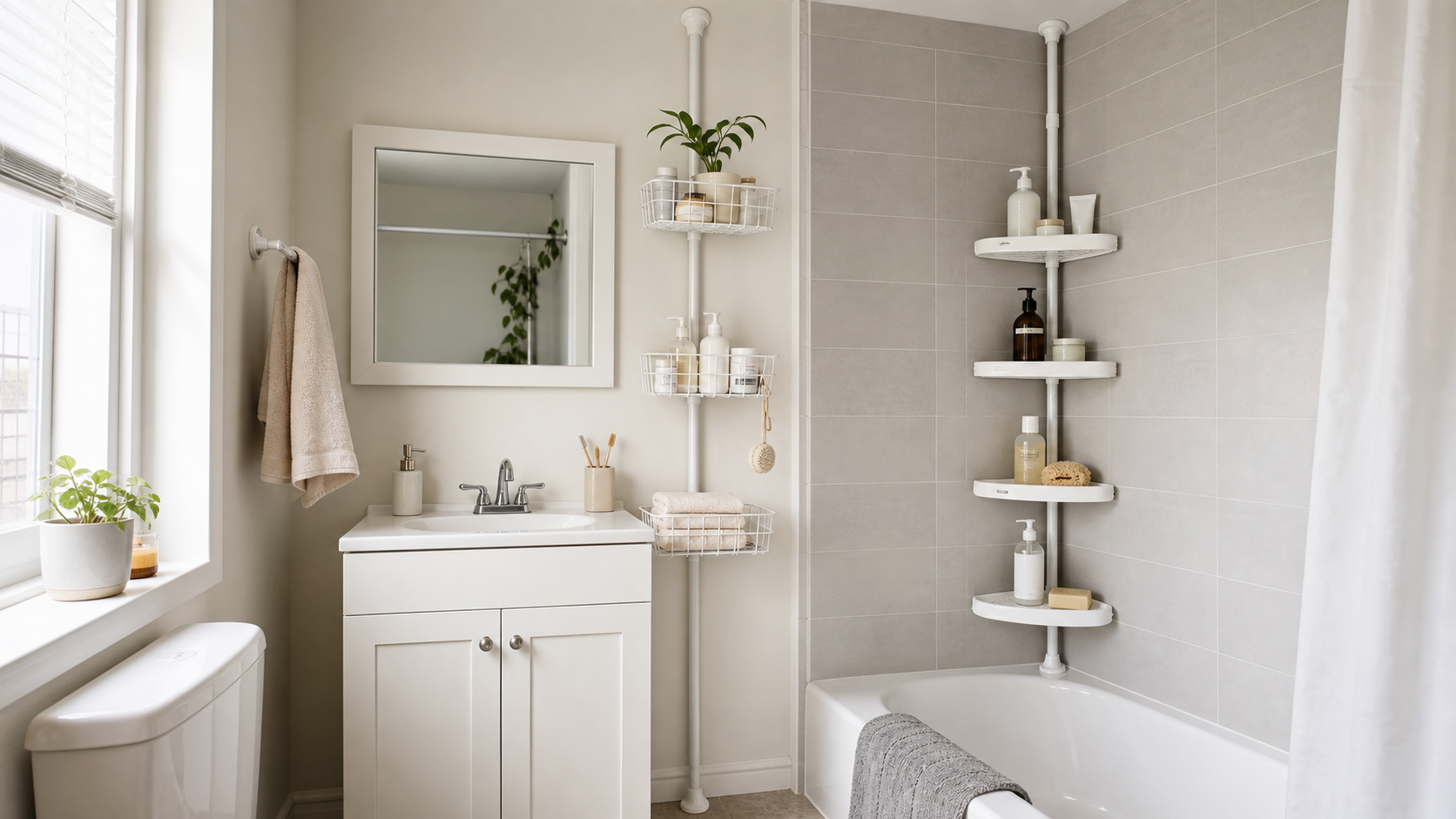
Compare bathroom tension shelves: Check the category, then measure your space and use the fit framework below before choosing a pole.
- Browse category: Shop bathroom tension shelves on AmazonCompare tub-corner caddies and floor-to-ceiling organizers by adjustment range, shelf layout, material, and stated load limits.
This guide compares product types, not tested winners. Confirm current dimensions, surface exclusions, load guidance, assembly instructions, care directions, and your lease before buying.
Tension shelves are one option within our broader renter-friendly home upgrades guide. If you only need shower storage on smooth tile, compare the smaller footprint and different mounting risks in our adhesive shower shelf guide. For storage above a toilet rather than inside a wet area, see the over-the-toilet storage guide.
Quick picks by bathroom setup
- Best for a tub or shower corner: a corrosion-resistant corner pole with ventilated, independently adjustable shelves.
- Best beside a vanity: a slim floor-to-ceiling pole with baskets that can face away from doors and drawers.
- Best for changing bottle sizes: a model with tool-free shelf adjustment rather than fixed shelf spacing.
- Best for uneven or questionable surfaces: skip tension mounting and use a stable freestanding organizer.
- Best to skip: any model whose adjustment range barely reaches the measured span or whose feet land on sloped, flexible, damaged, or textured surfaces.
What matters most
A tension organizer depends on compression between two surfaces. More pressure is not automatically better: too little can allow slipping, while too much can mark paint, stress a weak ceiling finish, or distort a flexible tub surface. Follow the maker's installation method and use the product only within its stated height range.
The storage job also matters. A few lightweight bottles in a shower corner create a different load from folded towels, spare toiletries, or bulk refill containers beside a vanity. Count what you actually plan to store, measure the largest item, and leave some unused capacity rather than treating every shelf edge as another hanging point.
Comparison framework
Tub-corner tension caddies
Corner caddies keep bottles off the tub rim and use vertical space that is otherwise difficult to reach. Look for shelf shapes that sit fully inside the corner, drain freely, and allow tall pump bottles to stand upright.
Choose one if: the upper and lower contact points are flat, firm, and permitted by the manufacturer, and the pole will not interfere with a shower curtain, door, grab bar, plumbing control, or access path.
Tradeoffs: the wet location exposes joints and coatings to soap residue and constant humidity. Shelves can rotate or slide when overloaded, and a sloped tub ledge may not provide a suitable lower contact point.
Floor-to-ceiling tension organizers
A floor-to-ceiling pole can add narrow storage beside a vanity or in an unused corner without consuming the footprint of a cabinet. Baskets usually provide better containment than flat shelves for small bottles and rolled washcloths.
Choose one if: you have a level, dry floor location and a sound, flat ceiling within the model's stated range.
Tradeoffs: the pole still occupies floor area, can block cabinet doors, and may leave compression marks. A tall narrow organizer also needs careful loading: heavier items belong low and should never exceed the maker's limits.
Multi-pole and ladder-style tension shelves
Wider tension systems may offer more usable shelf area, but they demand more exact alignment and more clear wall space. Each contact point needs a suitable surface, and all poles must remain vertical and evenly installed.
Choose one if: a single pole cannot hold the intended items and the wider unit fits without crowding the room.
Tradeoffs: assembly takes longer, the unit is more visually dominant, and small measurement errors can lead to rocking or twisted shelves. In a very tight bathroom, a freestanding narrow cart may be easier to reposition and clean around.
Must-have features
- A verified adjustment range: your measured span should sit comfortably inside the stated minimum and maximum, not at the last thread or extension.
- Surface-safe contact pads: broad, non-marking feet distribute pressure better, but they still need surfaces approved by the manufacturer.
- Positive shelf retention: collars, clamps, or locking tabs should keep shelves from sliding or rotating during normal use.
- Ventilated shelves: open wire or drain slots help water escape and make residue easier to spot.
- Bathroom-suitable materials: coated steel, aluminum, and plastic all require care; prioritize clear material and cleaning information over vague “rustproof” marketing.
- Useful shelf geometry: shelf depth, lip height, and spacing should fit the bottles or folded items you actually own.
Nice-to-have features
- Tool-free shelf adjustment: helpful when switching between pump bottles, jars, and small containers.
- Removable trays: easier to rinse and dry than shelves permanently trapped on the pole.
- Accessory hooks with stated limits: useful for a washcloth or shower puff, but not for heavy hanging storage.
- Replaceable feet or collars: practical when moving the shelf to a new rental with a different span.
- Simple joints: fewer exposed seams and decorative caps give residue fewer places to collect.
Measure before buying
Measure the vertical span in the exact location where the pole will stand. Take more than one measurement if the floor, tub edge, or ceiling may be out of level. Do not assume the room's advertised ceiling height matches a tiled shower recess or soffit.
Next, measure the usable corner or wall area at every planned shelf height. Include door swings, vanity drawers, toilet clearance, shower controls, curtains, windows, outlets, and any existing safety hardware. Check the largest bottle's height and base width, not just its volume.
Finally, confirm that both pressure points are allowed. Drop ceilings, flexible shower surrounds, sloped tub rims, damaged drywall, loose tile, textured surfaces, and freshly painted ceilings may be poor candidates. When the product instructions do not clearly support the surface, choose another storage method.
Setup and loading
Assemble the pole on a dry floor and follow the section order in the instructions. Install it plumb rather than leaning into the corner, apply only the directed tension, and test for movement before adding products. Recheck it after the first day and periodically thereafter because surfaces, joints, and loads can shift.
Put heavier, frequently handled items on lower shelves and keep the top light. Spread weight evenly instead of hanging bags or large bottles from one side. Never use the organizer as a handhold, grab bar, towel ladder, or support when entering or leaving a tub.
Cleaning and rust prevention
Rinse soap residue from wet-area shelves and wipe the pole using products allowed by its care instructions. Give shelves time to dry, especially around sleeves, collars, and contact pads. Avoid abrasive tools that can damage a protective coating.
Inspect for bubbling finish, rust spots, cracks, loose collars, compressed pads, or recurring movement. Remove a deteriorating or unstable organizer rather than adding more tension. Persistent moisture, wall damage, leaks, or loose tile needs attention from the property owner or an appropriate qualified professional; a shelf is not a moisture repair.
Renter and safety cautions
Check your lease before installing any pressure-mounted product. Photograph the contact surfaces, save the instructions, and do not add screws, glue, or construction adhesive to a tension system unless the property owner authorizes a different permanent installation.
Keep the organizer out of electrical-clearance concerns and do not relocate or obstruct grab bars, valves, access panels, ventilation, or required pathways. If installing it requires modifying tile, walls, plumbing, wiring, or a shower enclosure, stop and get property approval and qualified help.
Who should skip tension shelves
Skip this category if either contact surface is flexible, sloped, damaged, damp, or specifically excluded; if the only location blocks normal movement; or if household members may mistake the pole for a support rail. A freestanding caddy or property-approved installed shelf may be safer and easier to maintain.
Also skip a tension unit when you need to store heavy bulk supplies, stacks of towels, or many large bottles. These systems are best for a restrained everyday load, not as replacements for a cabinet or structural shelving.
Bottom line
For most small rental bathrooms, a corner tension caddy is the best fit for a modest shower-bottle load, while a slim floor-to-ceiling basket system works better beside a vanity. In either case, the winning feature is not the most shelves—it is a comfortable height range, suitable contact surfaces, stable shelf locks, drainage, and a load you can keep light.
Measure twice, follow the surface and load instructions, and check the pole periodically. If the room cannot provide two sound contact points without creating a hazard or move-out risk, choose freestanding storage instead.