Best Water Heater Leak Detectors for Utility Closets
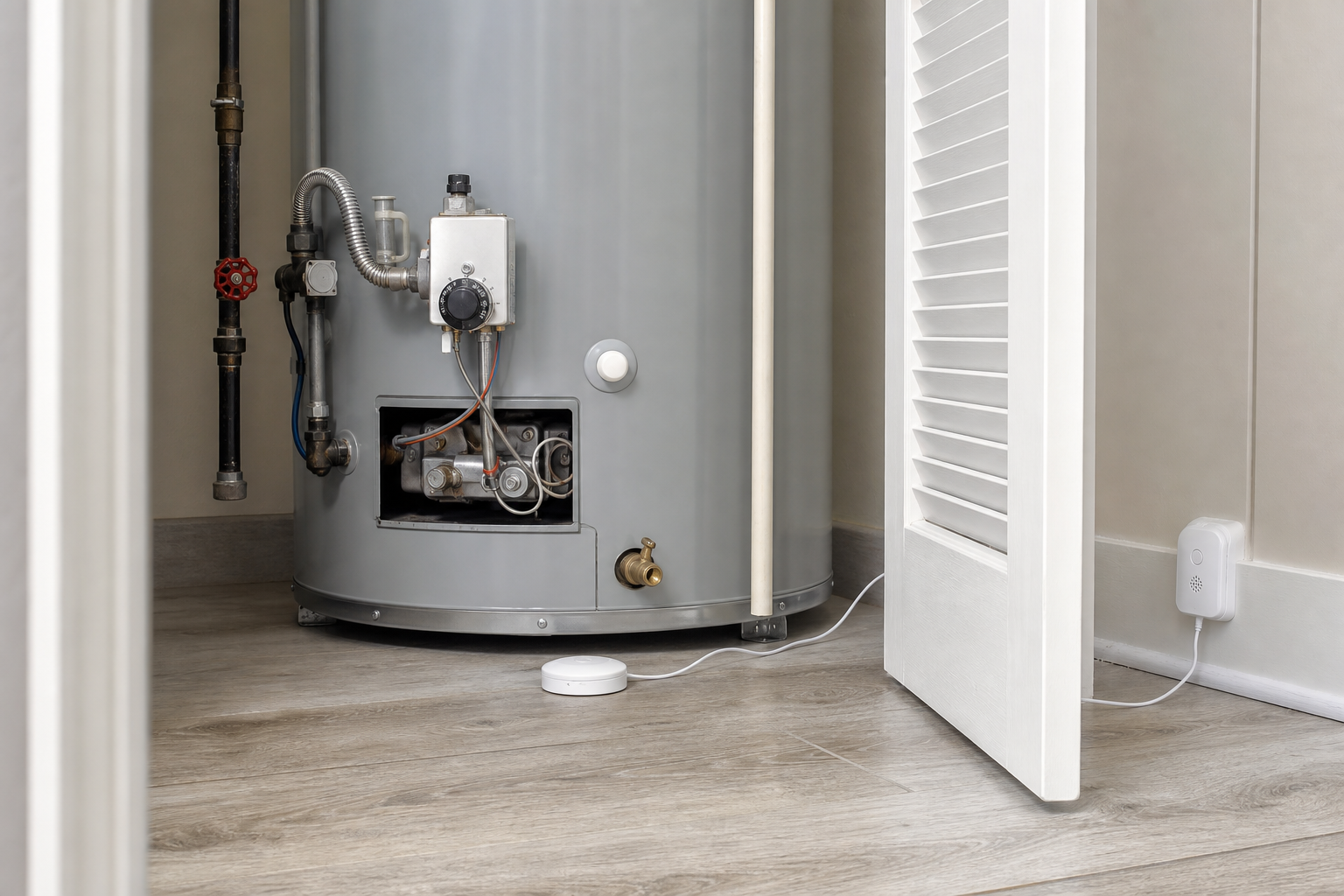
For most accessible utility closets, start with a loud battery-powered detector that can touch the lowest likely water path without blocking the heater, drain pan, controls, or service access. Add phone alerts when the closet is remote or the home is often empty, and use a sensor cable when one small set of contacts cannot cover the likely path around the tank.
As an Amazon Associate, The Good Home Doc may earn from qualifying purchases.
Compare coverage and alert reach first: These affiliate category links are shopping starting points, not tested rankings.
- Browse category: Loud local water leak alarmsA simple fit when the closet is near occupied rooms and the sensor remains easy to test.
- Browse category: Connected water leak detectorsUseful when remote alerts matter and floor-level connectivity is dependable with the closet closed.
- Browse category: Leak detectors with sensor cablesBetter for covering a curved path when the cable stays accessible and clear of heat and equipment.
Confirm contact layout, cable length, alarm volume, battery type, app or hub requirements, operating-temperature limits, reset method, and manufacturer placement instructions before buying.
A detector provides early warning; it does not stop water, contain a large release, identify the source, or make a damaged heater safe. Use the home leaks and moisture prevention guide for the broader inspection routine. For a different appliance setup, compare washing machine leak detectors.
Quick Picks by Utility-Closet Setup
- Best for a nearby, accessible closet: a stand-alone battery alarm with a loud siren, low-battery warning, and reachable test button.
- Best for a basement or rarely visited area: a connected detector that sends remote alerts and still sounds locally during an internet outage.
- Best for uncertain water paths: a sensing-cable model that covers a longer floor edge without crossing service or walking space.
- Best when the alarm body must stay outside the tightest area: a remote probe or cable with the main unit placed exactly as its maker allows.
- Best for unreliable Wi-Fi: a loud local alarm, or a hub-based system only after checking signal at the intended floor-level location.
Comparison Framework
Stand-Alone Floor Alarms
These detectors use contacts on their base or a short probe and sound when water bridges the contacts. They are simple, inexpensive, and independent of an account or network. Their limitation is alert range: a siren inside a closed mechanical closet may be difficult to hear across a home.
Choose one if: the closet is checked regularly and the alarm is audible from occupied rooms. Skip it if: the door, distance, or normal household noise makes a local-only warning easy to miss.
Wi-Fi or Hub-Connected Detectors
Connected sensors can notify a phone and may report battery or connection status. Compare direct Wi-Fi with hub-based systems, supported wireless bands, outage behavior, account sharing, notification permissions, and whether important alerts require a subscription.
Choose one if: away-from-home alerts solve a real problem and the intended location has reliable signal. Skip it if: the system will be ignored after setup, depends on an unsupported app, or loses connection with the closet door closed.
Remote Probes and Sensor Cables
A probe can monitor one difficult spot while the alarm body stays accessible. A sensing cable can cover more of the perimeter around a cylindrical tank or pan. Extra reach only helps when the cable is approved for the location, follows the actual low point, and remains visible enough to inspect and dry.
Choose one if: a longer sensing path materially improves coverage. Skip it if: the cable would touch hot surfaces, cross a drain, interfere with a door, disappear beneath equipment, or obstruct service access.
Map the Likely Water Path Before Buying
- Without opening panels or altering equipment, identify visible connections, the tank base, any existing pan, nearby drain, floor seams, and the lowest reachable point.
- Check whether a small amount of water would stay in a pan, run toward the closet opening, follow a wall, or disappear beneath flooring or equipment.
- Measure the available footprint and cable path. Keep required clearances, doors, louvers, drains, controls, valves, and service routes unobstructed.
- Close the closet door and decide whether a local alarm could be heard from bedrooms and normal occupied areas.
- For a connected detector, verify signal at floor level in the exact closed-door location before relying on notifications.
Must-Have Selection Criteria
- Useful contact geometry: the contacts, probe, or cable should meet the likely floor path without requiring a deep puddle.
- Accessible testing: you should be able to test, silence, inspect, dry, and replace batteries without moving the heater or entering a restricted space.
- Audible local warning: connected models should still provide a useful sound at the equipment location.
- Low-battery and offline warnings: the detector should make loss of power or connection noticeable.
- Stated environmental limits: confirm temperature, humidity, indoor-use, and placement limits for the actual closet.
- Clear reset instructions: know how to dry, retest, and return the sensor to service after it contacts water.
Nice-to-Have Features
- A replaceable remote probe: useful when one low point is hard to reach but the alarm body can stay accessible.
- Expandable multi-sensor alerts: helpful when the household also monitors laundry or sink areas and can maintain every unit.
- Alert history: useful for confirming an alarm occurred, though it cannot diagnose the source.
- Device naming and shared notifications: helps the right person identify the location quickly.
- Common replaceable batteries: simplifies routine maintenance when the product supports user replacement.
Placement, Heat, and Maintenance Tradeoffs
Follow both manufacturers' instructions. Do not place a sensor inside the heater cabinet, attach it to pipes or valves without approval, route a cable across burners, vents, drains, electrical equipment, access panels, or hot surfaces, or wedge it under the tank or supports. Never reduce combustion-air openings or door louvers.
Test on the maker's schedule and after battery replacement, app or router changes, or moving the unit. Confirm the local sound and every expected remote notification. Keep contacts clean only as directed, investigate corrosion or false alarms, and replace equipment that is cracked, unreliable, or no longer supported.
What a Leak Detector Cannot Do
A detector does not repair corrosion, shut off the supply, contain a failed tank, confirm that a drain pan is correctly installed, or determine whether the heater is safe. Automatic shutoff devices and drain changes are separate decisions that may affect plumbing, power, gas equipment, warranties, building rules, and local requirements. Use qualified help before modifying the system.
If water is already present, do not treat a new alarm as the solution. Avoid touching wet electrical equipment, controls, plugs, or cords. Contact building maintenance when applicable and call a qualified plumber or water-heater technician to evaluate the source. For gas odor, fire, sparking, or another immediate hazard, leave the area and follow local emergency and utility guidance.
Who Should Skip a Water Heater Leak Detector
Skip any detector that cannot be safely placed, heard, tested, or maintained in the real closet. Skip app-dependent products when connectivity or account support is unreliable. A detector is also the wrong next purchase when there is active water, tank or fitting corrosion, staining, a soft floor, repeated dampness, unusual sounds, damaged controls, or a blocked drain; those conditions need prompt evaluation rather than monitoring.
Renters should report water or equipment concerns and follow lease procedures instead of altering the heater, plumbing, pan, drain, gas, venting, or electrical setup.
Bottom Line
The best water heater leak detector reaches the first likely floor path, gives an alert the household will actually receive, and stays easy to inspect. Choose a local alarm for simplicity, add remote alerts when distance or absence justifies them, and use a sensor cable only when it improves coverage without entering hot, restricted, or service-critical space. Treat every alert as a prompt to find qualified help for the source—not as proof that the detector has prevented damage. If the wider room feels persistently damp without visible water, use the basement and bathroom hygrometer guide to track air-moisture trends while you investigate the cause.