Do You Need a Bathroom Humidity Monitor?
A bathroom humidity monitor is useful when seeing a trend will change what you do—such as running the fan longer, opening a permitted window, or documenting recurring dampness for a landlord. Skip it if you already know there is an active leak, visible damage, or a ventilation failure that needs repair rather than another reading.
As an Amazon Associate, The Good Home Doc may earn from qualifying purchases.
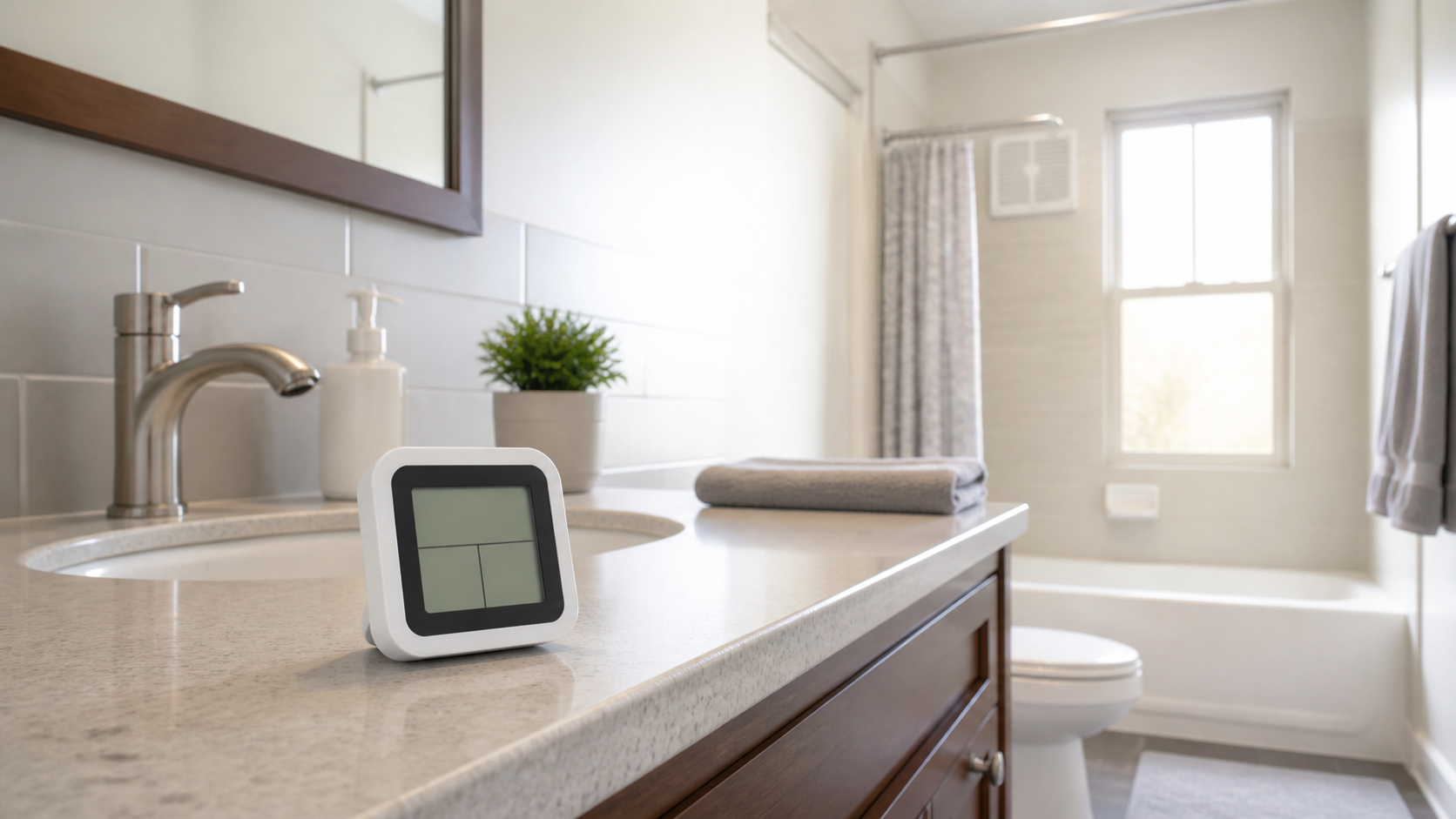
Compare the category after deciding that measurement will help: Browse category: Shop bathroom humidity monitors on Amazon.
This is a category starting point, not a tested ranking. Check the maker's stated accuracy range, refresh behavior, placement limits, alert controls, battery access, and bathroom-use instructions.
This page answers whether a monitor will help you make a decision, not which model wins. If the answer is yes, use the bathroom humidity-monitor buying guide for product criteria. For the broader problem—including leaks, condensation, and escalation—start with the home moisture-prevention pillar.
Quick Decision: Buy, Skip, Delay, Choose an Alternative, or Escalate
- Buy: the room feels damp after showers, you are willing to record or notice trends, and the result will guide a practical ventilation habit or a documented maintenance request.
- Skip: you want a gadget that automatically fixes moisture, identifies mold, proves a leak source, or certifies that the room is safe. A basic monitor does none of those jobs.
- Delay: you have not checked whether the exhaust fan actually runs, whether its grille is blocked, whether a window can be used safely, or where the monitor can sit away from direct spray and concentrated steam.
- Choose an alternative: use a simple timer or reminder if you only need to remember the fan, or address an obvious source such as a dripping fixture through the landlord or a qualified professional.
- Escalate: report or investigate active leaks, recurring wet surfaces, damaged finishes, persistent musty odors, visible growth, or an exhaust fan that does not operate or appears not to vent correctly.
When a Monitor Earns Its Keep
A monitor is most useful when the question is about patterns. Does the room stay damp long after a shower? Does opening the window, when allowed and weather permits, change the recovery? Does a household with back-to-back showers need a more consistent fan routine? A series of readings can make those habits easier to evaluate than mirror fog alone.
It can also help a renter describe a recurring problem without pretending to diagnose it. Dates, shower timing, visible condensation, odors, and readings from a consistently placed device give the property manager clearer context. They do not prove that a fan is code-compliant, locate a hidden leak, or establish the cause of damage.
Five Criteria That Decide Whether It Is Worth Buying
- A decision you can act on: Decide in advance what you will change if the room repeatedly stays damp—fan use, window use, shower spacing, or a maintenance request.
- Consistent placement: Put the device where its instructions allow, away from direct water, the immediate shower plume, an open window, and a supply vent. Moving it around makes trends harder to compare.
- Trend awareness: One number immediately after a shower says less than the rise and recovery under similar conditions. Treat the device as a pattern tool, not a pass/fail detector.
- Readable controls: A clear display, useful history or alerts, and controls you can silence matter more than extra modes you will not use.
- Upkeep you will actually do: Batteries, dust, splashes, resets, and occasional comparison with another device are small tasks, but neglected monitors become background clutter.
Cost, Setup, and Maintenance Tradeoffs
A basic monitor is usually a smaller commitment than changing ventilation equipment, but its value depends on whether it changes behavior or supports follow-up. Paying more for an app, remote sensor, or data history may be worthwhile for a hard-to-check room; it is wasted if a glance at a simple display is enough.
Setup should be simple: follow the current manufacturer directions, keep the monitor on a stable dry surface or use only its approved mounting method, and let it settle before comparing patterns. Do not place a non-water-resistant device where it can be splashed, and do not run an improvised power cord into a wet area.
Keep the sensor openings clear, replace batteries as directed, and watch for implausible jumps or a display that stops responding. If decisions matter, compare the trend with a second device or authoritative assessment rather than assuming a consumer sensor is exact.
Red Flags That Make Monitoring the Wrong Next Step
- Water is actively dripping, pooling, or entering around a fixture, ceiling, wall, floor, or window.
- Paint, drywall, trim, flooring, or cabinetry is swollen, soft, peeling, stained, or deteriorating.
- A persistent musty odor or visible growth returns after normal cleaning and drying.
- The exhaust fan does not turn on, makes unusual sounds, or appears to move little air.
- Condensation repeatedly spreads beyond the shower area or remains despite reasonable ventilation habits.
- Anyone has health symptoms or another concern that requires advice from an appropriate health or indoor-environment professional.
Who Should Skip a Bathroom Humidity Monitor
Skip it if you will not use the readings to change a habit, compare a trend, or communicate a problem. A timer, written fan routine, or property-maintenance request may be a clearer tool. Also skip consumer monitoring as a substitute for investigating obvious damage or a known ventilation problem.
People looking for proof about mold, indoor-air safety, hidden leaks, or building compliance need a different path. A humidity reading is context, not a diagnosis. The home moisture-meter decision guide explains a related screening tool and its limits, but visible or recurring damage still calls for qualified help.
Monitor, Timer, Better Habit, or Repair?
Choose a monitor when uncertainty about the room's pattern is stopping you from acting. Choose a timer or reminder when you already know the fan helps but forget to use it consistently. Change the routine when shorter or spaced showers, an open door after use, or an approved window can safely improve drying.
Request a repair or professional assessment when the fan is broken, dampness keeps returning, building materials are affected, or a leak is plausible. Renters should document the condition and use the property's maintenance process. Do not open walls, alter ventilation, or make electrical changes based on a monitor reading.
Bottom Line
You need a bathroom humidity monitor only when a visible trend will help you improve ventilation habits or document a recurring problem. Buy a simple, maintainable device after choosing a safe and consistent location. Skip it when it will only confirm what you already know, and escalate obvious leaks, damage, persistent odors, visible growth, or ventilation failures instead of waiting for more data.