Best Heated Throws for Drafty Living Rooms
A heated throw is a close-range comfort tool for one seated adult—not a repair for a cold room. The useful comparison is less about maximum heat and more about coverage, a reachable controller, a sensible cord route, straightforward washing, documented shutoff behavior, and instructions that fit how you will actually use it.
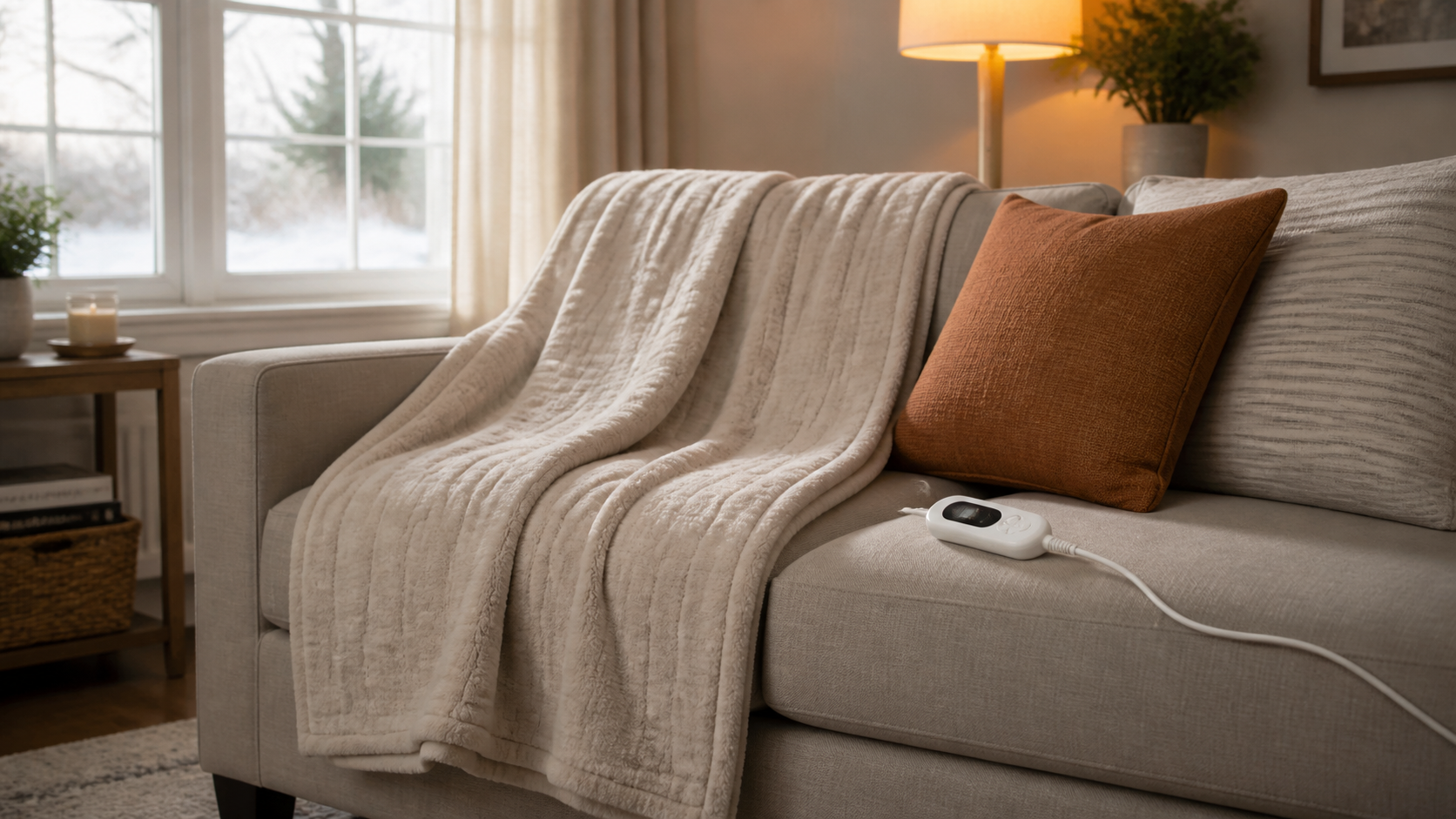
As an Amazon Associate, The Good Home Doc may earn from qualifying purchases.
Compare the format that fits your seat and routine:
- Browse category: Compare heated throws with automatic shutoffStart with models whose current instructions state the shutoff time, controller use, and permitted setup.
- Browse category: Compare machine-washable heated throwsCheck the complete disconnect, wash, dry, and inspection directions before treating washability as convenient.
- Browse category: Compare oversized heated throwsUseful when standard throws leave legs uncovered, provided extra fabric will stay flat and away from reclining hardware.
These are category searches, not tested rankings. Verify the current manufacturer instructions, dimensions, controller and cord layout, shutoff behavior, care requirements, condition on arrival, and return terms before buying.
This guide compares heated-throw categories and buying criteria without naming a universal winner. Features and instructions change between models, so the product manual and label—not a generic article—must govern setup, use, washing, storage, and replacement.
Quick Best-Fit Guide
- Best starting point for a reading chair: a standard throw that covers lap and legs without trailing into a walkway.
- Best for a deep sofa: a longer or oversized throw with a cord long enough to reach the outlet without an extension cord.
- Best for simple operation: a plainly marked handheld controller with a few distinct settings and documented automatic shutoff.
- Best for regular use: a model with realistic wash instructions, a fully removable controller connection, and a fabric finish you can inspect easily.
- Best when the room itself is very cold: skip the throw as the first fix and investigate drafts, heating, windows, doors, or landlord maintenance instead.
Measure the Seat, Person, and Cord Route
Measure the throw you already find comfortable from lap to feet, then compare that with the listed blanket dimensions. A standard heated throw is meant for personal coverage; it may not cover two adults or work like a bed-size electric blanket. More fabric is not automatically better if it bunches under the user, drapes across a walkway, or reaches moving recliner parts.
Map the cord from the controller connection to the wall outlet before buying. The route should avoid pinching under furniture, crossing a walking path, wrapping around reclining mechanisms, or sitting where children or pets can pull it. Do not plan around an extension cord, power strip, smart plug, or timer unless the manufacturer explicitly permits that setup.
Comparison Framework
Standard Throws
Standard formats suit one seated person and are easier to keep within the sofa or chair footprint. They usually leave less spare fabric to fold or bunch, but dimensions vary enough that tall users should check actual length rather than relying on the word “throw.”
Choose one when: you want lap-to-foot warmth in one regular seat and can keep the complete cord route visible and clear.
Oversized Throws
An oversized throw can cover shoulders or longer legs more comfortably. The tradeoff is fabric management: excess material can slide to the floor, collect beneath a recliner, or encourage folding that conflicts with the instructions.
Choose one when: measurements show that a standard throw is too short and the seat has enough clear space for the larger footprint.
Simple Versus Feature-Heavy Controllers
A few distinct settings can be easier to use by touch than a controller crowded with modes. Backlighting, memory, or extra heat steps may help some users, but only if the display remains legible and the buttons are easy to distinguish. Automatic shutoff is a backup feature, not permission to leave a throw unattended.
Choose the controller first when: hand comfort, eyesight, nighttime use, or control placement is likely to determine whether the throw is pleasant to use.
Plush, Sherpa-Style, and Low-Pile Fabrics
Plush layers can feel warm before power is turned on and can mask the feel of internal wires, while lower-pile fabrics may be easier to inspect for wear and quicker to dry. Reversible sherpa-style throws add bulk and can trap lint. Fabric choice affects comfort and upkeep, but it does not override electrical care instructions.
Must-Have Buying Checks
- Current instructions are available: Read the use, wash, dry, storage, and warning sections before the return window closes.
- Automatic shutoff is documented: Confirm the stated duration and whether restarting requires a manual action.
- The controller is reachable: It should not require twisting, leaning into a walkway, or digging beneath cushions.
- The cord reaches safely: The supplied cord should reach a suitable wall outlet without being pinched, covered, or stretched.
- The connector fully detaches for care: Confirm every step required before washing and reconnecting.
- The product can be inspected: You should be able to spot damaged fabric, exposed wiring, a loose connector, discoloration, or a controller problem and stop using it.
Nice-to-Have Features
- Clearly spaced settings: Easier than cycling through many nearly identical modes.
- A long controller lead: Helpful when the connector would otherwise pull toward the edge of the seat.
- Wash reminders on the label: Useful when the detachable parts and drying limits are easy to forget.
- Lightweight fabric: Easier to reposition flat and lift into a washer that meets the stated care directions.
- A neutral controller light: Visible enough to confirm status without becoming distracting in a dim room.
Use and Care Limits Matter More Than Extra Heat
Follow the maker's instructions about preheating, folding, layering, sleeping, reclining furniture, storage, and use by children, pets, or anyone who may not notice heat or operate the controls reliably. Keep the throw flat as directed and never use it when wet. Do not place heavy objects on it or tuck the wired area into cushions unless the instructions explicitly allow that arrangement.
Before each use, check the fabric, plug, cord, controller, and connector. Stop using the throw if you see fraying, scorch marks, exposed or displaced wiring, a cracked controller, a loose connection, uneven heating, or operation that differs from the manual. Do not attempt an electrical repair. Contact the manufacturer about warranty or replacement guidance.
For washing, disconnect every part exactly as directed, use only the permitted cycle and detergent, and complete the required drying method before reconnecting. If your washer, dryer, or drying space cannot meet those directions, choose a different model or a conventional washable throw.
Who Should Skip a Heated Throw
- Skip it when the intended user cannot reliably feel excessive heat, move the throw, or operate the controller; ask an appropriate clinician or caregiver about safer comfort options.
- Skip it for unsupervised children or pet bedding, and follow every age and use restriction in the product instructions.
- Skip it on a seat where the cord would cross a walkway, pass through moving recliner hardware, or require an unapproved extension cord or power strip.
- Skip it if the throw will regularly be folded tightly, sat on, pinned under cushions, used while wet, or left running unattended.
- Skip it when the home's outlet, plug, wiring, or breaker shows heat, discoloration, looseness, buzzing, sparking, or repeated trips. Stop use and contact a qualified electrician or the property manager.
Fix the Draft When the Throw Is Only a Workaround
A heated throw can make a chair comfortable while you read, but it should not conceal a failing heating system, a window that will not close, water intrusion, or a door with a large uncontrolled gap. Renters should document significant cold or damaged windows and contact the landlord or property manager. Homeowners may need an HVAC technician, window professional, or energy assessment when room temperatures stay unusually low.
For a narrow, reversible fix, compare temporary door-frame draft seals or renter-friendly window insulation kits. Keep any draft product clear of required door operation, ventilation, and emergency routes.
Bottom Line
The best heated throw is correctly sized for one seat, easy to control, compatible with a clear wall-outlet route, washable under instructions you can realistically follow, and backed by documented shutoff and care guidance. Choose by fit and maintenance rather than maximum heat. If the setup requires improvised power, hides damage, or serves as a substitute for a serious room-heating problem, skip the category and address the underlying issue.