Cable Box vs Cable Sleeve for Home Cord Clutter
A cable box hides a power strip and the plug cluster around it. A cable sleeve gathers several cords along the route they share. They solve different parts of the mess, so start by locating the clutter rather than choosing the tidier-looking product.
As an Amazon Associate, The Good Home Doc may earn from qualifying purchases.
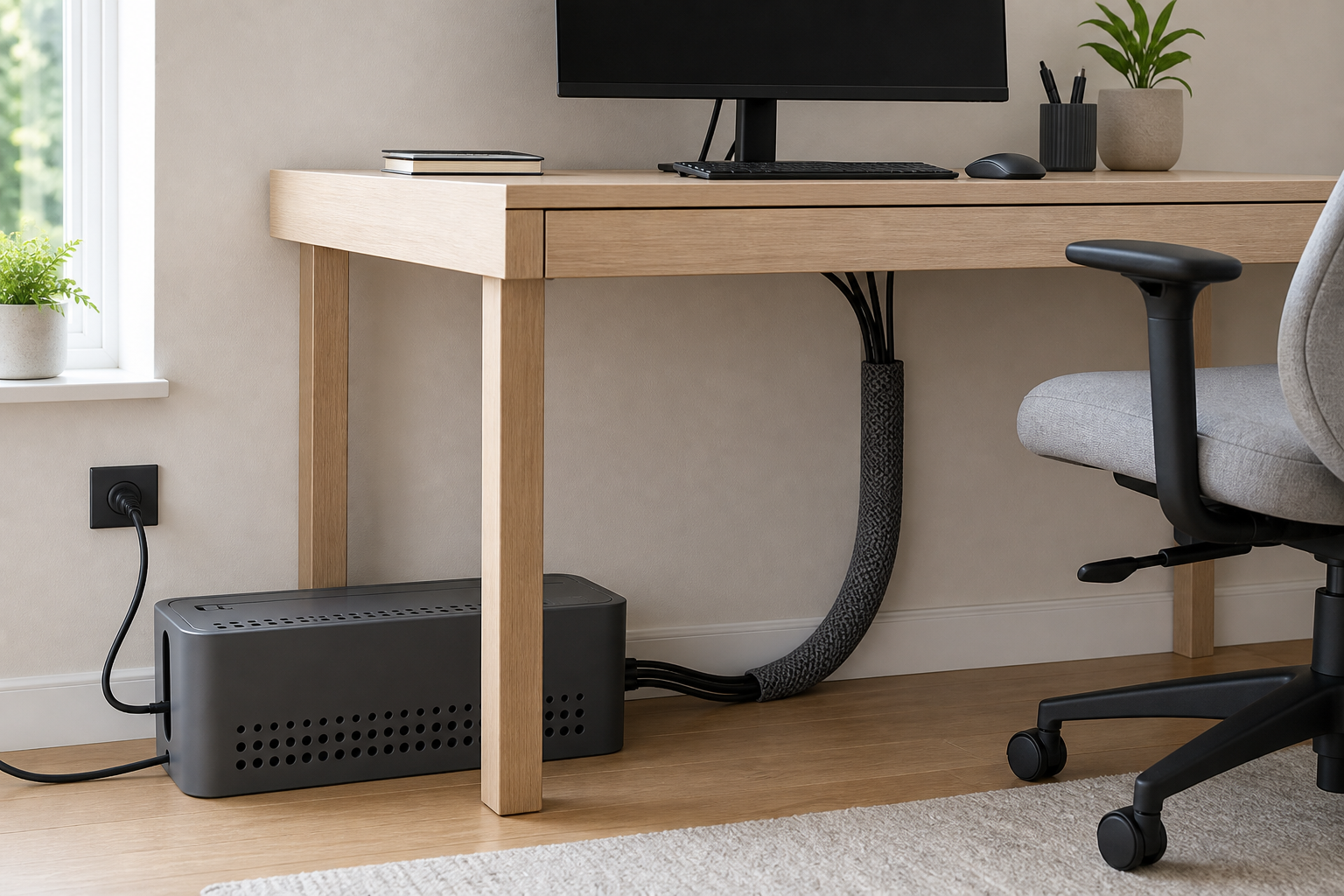
Compare the two formats
Contain the plug cluster or bundle the cable run
Use a box around a compatible power strip when bulky plugs are the problem. Use a sleeve when several cords travel together and still need to bend around furniture.
This is a format comparison, not a tested brand ranking. Dimensions, permitted devices, ventilation instructions, cable capacity, and cleaning directions vary. Read the current manufacturer instructions for the power strip, connected equipment, box, and sleeve before setup. If a box fits your problem, continue with the cable management box buying guide for loaded-strip measurements, lid access, and placement checks.
Quick Answer
Choose a cable management box when the untidy point is a floor- or desktop-level power strip with bulky plugs and extra cord length. Measure the complete loaded strip, provide the ventilation and clearances its makers require, and keep switches and status lights accessible.
Choose a cable sleeve when several compatible cords follow the same route from a monitor, TV, computer, lamp, or charging area. A sleeve makes the run look like one bundle while allowing you to open it for changes.
Use neither as a repair. Stop using a cord, plug, outlet, power strip, or adapter that is hot, damaged, loose, discolored, sparking, buzzing, or repeatedly tripping protection. Do not conceal the warning sign; disconnect it safely and seek qualified electrical help when needed.
Side-by-Side Tradeoffs
| Decision point | Cable management box | Cable sleeve |
|---|---|---|
| Problem solved | Contains a power strip, plugs, and short loops of excess cord | Bundles several cords that travel along the same route |
| Measurement priority | Loaded strip length, width, height, plug orientation, and cable exits | Bundle diameter, run length, branch points, and bend radius |
| Access | Lid may slow access to switches, indicators, and plugs | Wrap or zipper must open when one cable changes |
| Cleaning | Box can be moved and wiped; dust can collect around openings | Textured sleeves can hold dust and may need removal for cleaning |
| Best location | Stable, dry surface away from foot traffic and blocked ventilation | Behind furniture or along a protected shared cable route |
| Main limitation | Does not organize the full cable run | Does not contain a power strip or bulky plug cluster |
Who a Cable Management Box Fits
A cable box fits a concentrated plug problem. It can visually contain a power strip, adapters, and modest slack beneath a desk or media console without attaching anything to the wall. That freestanding setup can work for renters when it stays clear of walkways and does not interfere with furniture or cleaning.
The box must fit the strip after every plug and adapter is installed. A power brick can add height or block the next outlet. Side and end openings need to align with cords without pinching them against the lid or forcing sharp bends. Confirm that the box maker permits the intended use and follow all ventilation and loading directions for the electrical equipment inside.
Cable box setup checks
- Measure the loaded strip: Include plugs, adapters, switches, indicator lights, surge-status windows, and cable strain reliefs.
- Keep access practical: You should be able to inspect, unplug, or switch off equipment without dismantling the room.
- Protect airflow: Do not cover required vents, pack the box tightly, place it on soft material that blocks openings, or add fabric for appearance.
- Choose a stable location: Keep it dry and away from door swings, chair wheels, vacuum paths, heaters, and places where it could be kicked.
- Control extra length: Arrange only gentle loops; do not crush, tightly coil, knot, or sharply bend cords.
Who a Cable Sleeve Fits
A sleeve fits the route rather than the outlet cluster. It is useful when monitor, speaker, keyboard, charging, or entertainment cables leave the same area and run together behind furniture. Split-wrap, spiral, zipper, and hook-and-loop formats open differently, so choose around how often devices move.
Before buying, count the cords at the thickest section and measure the distance between the first and last useful branch points. The sleeve should close without compressing the bundle and should let individual cords exit without a tight turn. Keep wall-power cords and low-voltage data cables arranged according to applicable product instructions; when in doubt, use separate routes.
Cable sleeve setup checks
- Size for the thickest point: Include connector ends if they must pass through rather than wrap into the sleeve.
- Map branch points: Note where each monitor, speaker, charger, or peripheral cord needs to leave the bundle.
- Allow movement: Leave gentle slack for sit-stand desks, monitor arms, and adjustable furniture.
- Avoid moving hazards: Keep the bundle clear of chair casters, hinges, drawer slides, reclining furniture, and robot vacuums.
- Plan changes: A re-openable wrap is easier than a narrow spiral sleeve when devices change often.
Heat, Power Strips, and Access
Neither organizer changes what a power strip, extension cord, adapter, or appliance is designed to handle. Do not daisy-chain power strips or extension cords, defeat grounding, or use an indoor organizer where moisture or outdoor exposure is possible. High-draw equipment may have specific instructions that rule out a shared strip or concealed setup.
Heat claims should come from the current instructions, not from a box having holes or a sleeve being marketed as breathable. Keep the setup inspectable. If a plug or cord feels unusually warm, smells hot, shows damage, or behaves differently after organization, disconnect it safely and investigate the equipment rather than adding more concealment.
Cleaning and Maintenance
Unplug equipment according to its instructions before moving an organizer for cleaning. Wipe a box with the method its material allows and remove dust from openings. Check that the lid, cable exits, and furniture have not started pressing on cords.
Inspect a sleeve anywhere it crosses an edge or enters moving furniture. Dust can cling to woven and hook-and-loop material. Open the sleeve periodically so you can find abandoned cords, check jackets for wear, and prevent the bundle from growing beyond its intended fit.
Pets, Children, and Shared Rooms
A closed box can reduce casual access to plugs, but it is not automatically child-resistant or pet-proof. A curious child may lift a lid, and a pet may still reach cords at each opening. Use only products explicitly designed for the household risk you need to manage, follow their instructions, and keep electrical equipment out of reach where practical.
A sleeve can make several loose cords less tempting, but exposed ends remain. Skip fabric or mesh where a pet chews textiles, and do not route any bundle where it can be pulled onto a person or animal.
Who Should Skip Each Option
Skip a cable management box when
- The loaded power strip and adapters do not fit with easy access and manufacturer-required clearance.
- The only available location is damp, carpeted in a way that blocks openings, inside tightly enclosed furniture, or exposed to kicks and chair wheels.
- You need to see or operate the strip’s switch, protection indicator, or plugs frequently.
- The real problem is a long cable route or a cord crossing a walkway.
Skip a cable sleeve when
- The problem is bulky plugs and a power strip rather than the cords leaving them.
- Cords split in many directions, move independently, or must be swapped every day.
- The available route crosses a walkway, gets pinched by furniture, or forces sharp bends.
- The bundle mixes equipment in a way that conflicts with manufacturer instructions or applicable requirements.
When It Makes Sense to Use Both
A desk or TV zone may use a box for a compatible power strip and a sleeve for the cords that leave that zone. Treat them as two separate measurement jobs. The box still needs ventilation and access; the sleeve still needs suitable capacity, branch points, and a protected route. Do not run the sleeve through a box opening unless both products and every cord fit without pressure or tight bends.
Bottom Line
Choose a cable box when you need to contain one measured plug cluster. Choose a cable sleeve when you need to gather one shared cable run. If the mess spans a floor or wall rather than staying behind furniture, compare renter-friendly cord covers instead. For clips, ties, trays, and other zone-specific choices, continue to the cord organizer guide.